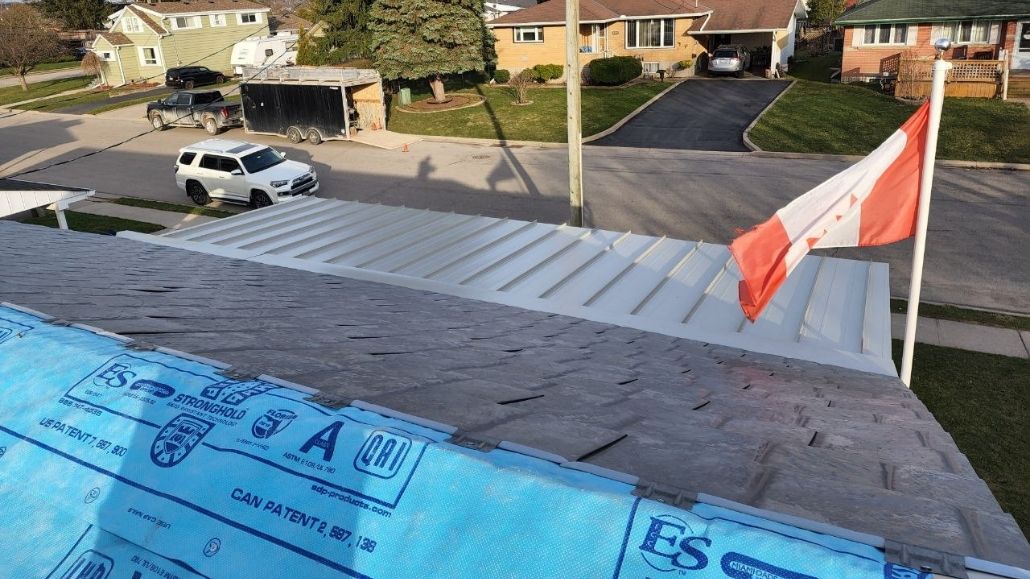
It’s one of the most common questions I get on a quote call: “Can I just put a metal roof right over my old shingles?” And almost every time someone asks it, one of two things is going on. Either they’ve been told something different by another metal roofing contractor and they’re trying to figure out who’s right — or they don’t love the idea of layering a brand-new roof over an old one, and they want me to tell them it’s a bad idea.
So let me give you the straight answer, the conditions that go with it, and everything I’ve learned.
✓ The short answer
If you have one layer of asphalt shingles and the roof deck underneath is solid and sound, you can install a metal roof right over top — and I’d be comfortable recommending it to my own family. (The roof deck is the layer of plywood, OSB, or wood boards your shingles are nailed to — the surface everything else sits on.)
! The exceptions
If you already have more than one layer of shingles, or the deck shows sagging, rot, or mould that can’t be remediated, the old roof needs to come off first. More on exactly why below.
When you can go over the shingles — and when you can’t
The whole decision comes down to two things: how much weight is already up there, and whether the surface underneath the shingles is still in good shape.
One layer only — and here’s the weight math
Now, in my opinion, a roof shouldn’t have more than one layer of shingles on it in the first place — I’m not a fan of layering shingles at all — and unfortunately we do still run into two layers from time to time. The reason it matters is weight. An average architectural asphalt shingle weighs roughly 250 to 300 lbs per 100 square feet of roof. With two layers already up there, you’ve added a substantial load to the structure before any steel goes on. Adding a metal roof on top of that — a roof that’s meant to last 50-plus years — is just a lot of long-term stress on the home.
This isn’t only my opinion. Under the Ontario Building Code, a roof is allowed to carry up to two layers of asphalt shingles — your original layer plus one overlay on top of it — unless a structural engineer signs off on more. The reason the code draws the line there is exactly the one above: preventing excess weight and structural problems. So if you’re already carrying those two layers, adding a metal roof over top isn’t on the table — the old shingles need to come off first.
A solid substrate underneath
The substrate — whether it’s wood boards, plywood, or OSB — needs to still be solid. It shouldn’t be sagging between the rafters, and on board decks it shouldn’t be missing big chunks. It also needs to be free of mould, or at least in good enough shape that mould remediation can be done from the underside in the attic. If the deck can’t be saved that way, then the shingles and the sheathing both need to come off and be replaced before any new roof goes on.
Photo placeholder
A close-up shot from inside an attic looking up at the underside of the roof deck — ideally showing healthy, dry sheathing on one side and (if you have it in your photo library) a water-stained or deteriorated section on the other. This grounds the “is the deck sound?” point visually.
“But if you don’t tear it off, how do you know the deck is sound?”
This is the single most common argument against going over the top, and I want to address it honestly, because in some situations it’s a fair point. If you have a cathedral ceiling with no attic space to inspect from below, then yes — there could be a soft spot or a piece of rotten plywood up there that we can’t see going in. I won’t pretend otherwise.
Here’s how we manage it in the real world. First, when a deck problem is serious enough to matter, it almost always announces itself: a leak bad enough to rot plywood is a leak the homeowner has usually noticed inside the house. When that’s the case, we recommend removing the shingles in that area and confirming the deck before we go any further. Second, we tell every homeowner up front that if our crew is walking the roof and feels a soft area underfoot, we stop and have the conversation right there — pull the shingles in that spot, check the plywood, and replace it if it needs it. So it’s not “cover it and hope.” It’s a process with built-in checkpoints, and you’ll always know before anything gets buried.
What the building code and the manufacturers actually say
Permits: In Ontario, re-roofing generally doesn’t require a provincial or municipal building permit, as long as you’re not altering the structure.
The code: As mentioned, the one-overlay rule is real and it’s about weight. Two roof coverings is the cap on most homes without engineer approval.
The manufacturer — and this is the part people get backwards: Homeowners (and even some roofers) will tell you the shingle manufacturer requires the old layer to be torn off. That’s not actually true for asphalt-over-asphalt — the big asphalt shingle makers will let you recover over one flat layer with a sound deck. But here’s the thing that matters for your project: those are asphalt shingle instructions, and you’re installing metal. The asphalt maker’s recommendation has nothing to do with your job. The spec that actually governs a metal install is the metal manufacturer’s — and that’s a distinction almost nobody draws. We’ll come back to what the metal manufacturers require for warranty at the very end.
How it’s actually installed — the system changes everything
“Going over the shingles” isn’t one process. It depends entirely on which metal system you’re putting on.
Steel shingles — a direct-deck system
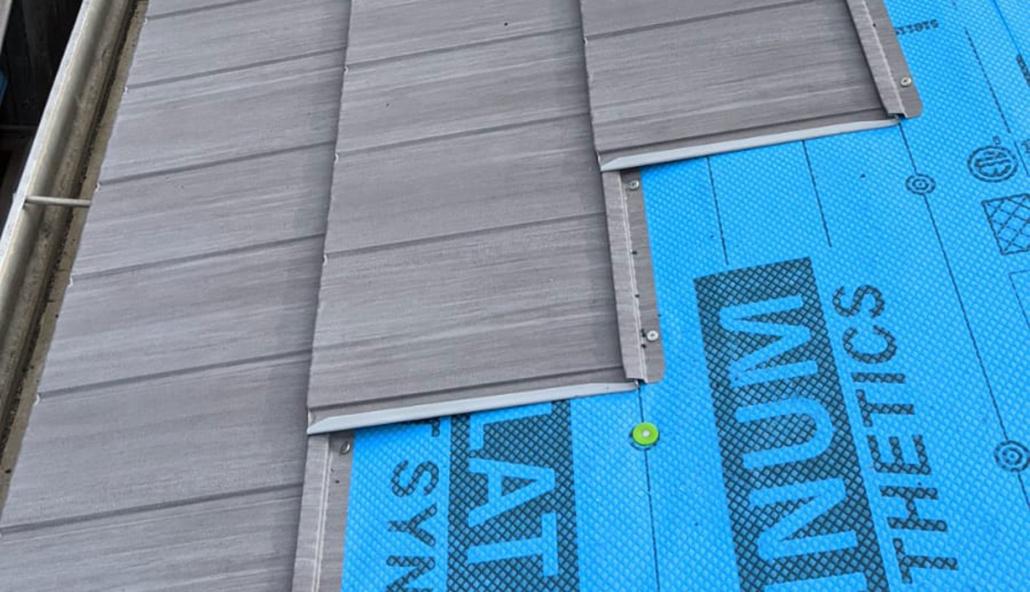
Steel shingles are what we call a direct-deck system. When we re-roof over existing asphalt with steel shingles, the process is:
- Remove all the existing drip edges at the eaves, gables and rake edges — anything hanging past the edge gets cut back and taken off.
- Remove all the ridge and hip caps.
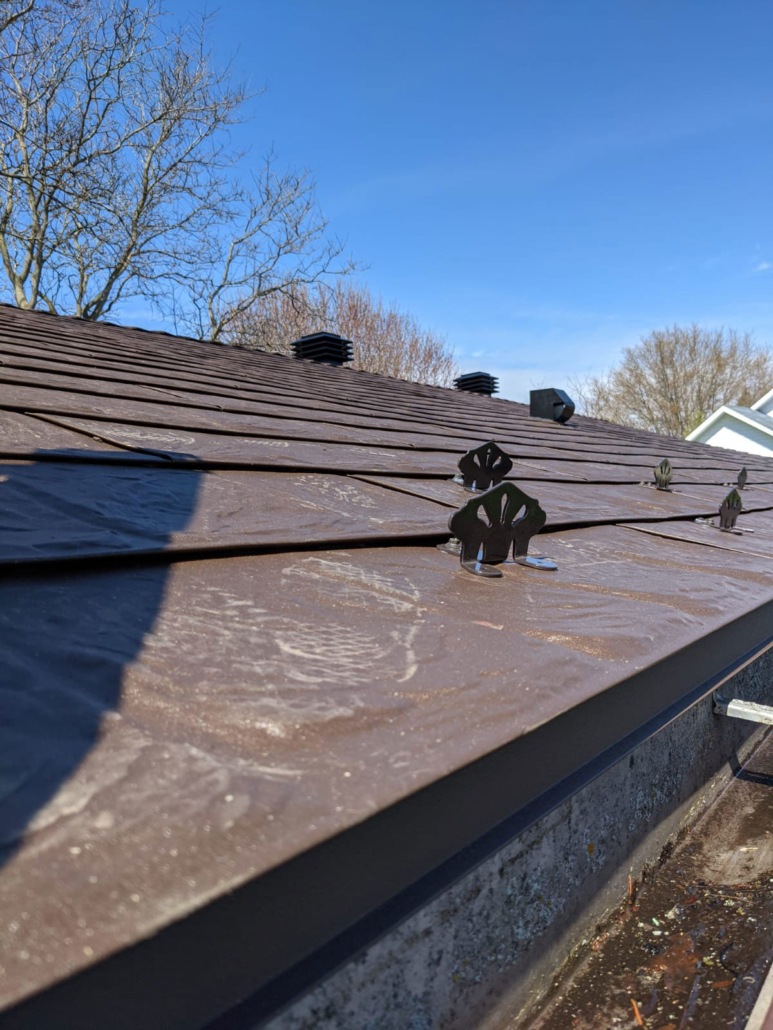
- Install a synthetic underlayment over top of the existing shingles.
- Install the new steel shingle system over top of that.
Standing seam — a few good ways to do it
Standing seam is different, because the flatter the surface underneath it, the better the finished roof looks. If your roof is already straight and doesn’t need leveling, then best practice is straightforward: remove the existing shingles, install an ice and water shield over the plywood or decking, and install the standing seam directly over that ice and water shield.
But here’s the part that matters: removing the shingles doesn’t automatically give you a straight roof. If the decking itself has big dips or waves in it, laying the panels straight onto that deck won’t hide them — you’ll still see them in the finished metal. To get the straightest possible surface on a roof that isn’t already flat, we double strap it — vertically, then horizontally — and shim that grid level. The strapping grid is what actually straightens the plane, and it can be built over a torn-off deck or right over the existing shingles. The prep over shingles is the same either way: remove the drip edges, take off the ridge and hip caps, lay synthetic underlayment over the shingles, then install the wood strapping over top of that.
The reason we go to all this trouble is oil canning — the slight waviness you sometimes see in flat metal panels. The straighter the surface, the less oil canning shows. None of this changes how the roof functions or performs; a roof laid over dips will keep the water out just as well. It’s purely about aesthetics — standing seam simply looks its best on a straight plane. (Worth knowing: steel shingles don’t oil can. Standing seam does. So this is a standing-seam consideration specifically.)
And yes — we can install standing seam directly over the existing shingles with no strapping at all. It makes a sound, watertight roof. But because the shingle surface underneath won’t be flat, it’ll show the most oil canning of any of these approaches. If you love the look of standing seam and you go in understanding that it won’t lay perfectly straight, it’s still a legitimate option. It just comes down to whether that aesthetic tradeoff is one you’re comfortable with — the roof will perform either way.
A quick word on fasteners
People sometimes ask whether the screws can really hold properly through an extra layer of roofing. The answer is straightforward: when we go over an existing roof, we use fasteners long enough to pass through the shingles — one layer, since we never install over two — and bite securely into the deck below. It’s something we account for as a matter of course, not a weak point in the system.
Photo placeholder
A jobsite photo of a roof mid-install with the vertical-then-horizontal batten grid clearly visible over the synthetic underlayment, before the standing seam panels go on. If you can capture one where the shimming under a strap is visible, even better — it shows the craftsmanship behind a straight plane.
The big objection: “Won’t moisture get trapped under there?”
This is probably the question I’m asked most. Right after it rains, people worry about water being trapped between the old shingles and the new metal, slowly rotting the deck.
Trapped rain moisture — mostly a myth, when it’s done right
Two reasons. First, the synthetic underlayment we use has no adhesive on the back. It doesn’t stick down, so it doesn’t act like a pool liner sitting on top of your shingles, holding water. Second — and this surprises people — neither asphalt shingles nor metal roofing are airtight systems. There are no seals between every joint. So even if you installed metal over a damp asphalt roof, that moisture can still evaporate out. It won’t sit there and rot the deck below.
! The real risk: backside condensation — and one strapping mistake
The moisture that can cause trouble is condensation that forms on the back of the metal. The synthetic underlayment we install under every metal roof is the first line of defence against it. But the bigger failure I see is a strapping mistake: some installers strap the roof horizontally only over the existing shingles. Every horizontal strap then acts like a little dam, trapping water and condensation behind it. I’ve torn off plenty of those roofs. That’s exactly why we strap vertically first, then horizontally — so any moisture runs straight down to the bottom edge of the roof instead of pooling behind a strap and rotting the wood.
The ventilation truth most roofing contractors won’t tell you
In the southwestern Ontario metal roofing market, a lot of companies install exposed-fastener systems on strapping, and many of them double strap. They promote it as creating “airflow” under the metal roof. I want to be honest with you about this: there is no benefit to airflow between your metal roof and your old roof. Simply putting metal on strapping doesn’t create any meaningful airflow, and most of these companies don’t actually do anything to move air from the bottom of the roof to the top. It’s more of a sales gimmick than a real performance feature.
What actually protects your roof is attic ventilation — specifically, adequate intake and exhaust ventilation working together. The moisture that threatens a roof is created inside your home, rises, and collects in the attic. Controlling and venting that attic moisture properly is where the health of the whole roof system comes from. Remember: metal roofing is watertight, not airtight. Any moisture between the old roof and the new metal will evaporate. You don’t need an air gap under the steel to make that happen.
✓ What to ask any metal roofer
Don’t ask “do you create airflow under the metal?” Ask “how are you confirming my attic has adequate intake and exhaust ventilation?” That’s the question that actually protects your roof deck and the structure underneath it.
And no — the old shingles aren’t insulating your home
You’ll also see it claimed that leaving the old shingles in place adds insulation value. It doesn’t, in any meaningful way. Asphalt shingles have almost no R-value — technically everything has some, but nobody packs asphalt shingles into their walls to keep a house warmer or cooler, because they don’t work that way. Keeping them up there for “extra insulation” accomplishes essentially nothing. If energy efficiency is your goal, that comes from the metal’s reflective coating and proper attic insulation and ventilation — not from the layer you’re covering up.
What it costs to tear off versus go over
When we remove the existing shingles, we install a high-heat (high-temperature) ice and water shield across the whole roof, then the metal on top. That tear-off route runs roughly $3 to $4 a square foot more than going over the existing shingles — a figure that carries the bin rental, the disposal of the old shingles, and the considerable extra labour a full removal takes.
We sometimes get pushback on that number, and it’s worth explaining why it’s higher than people expect. When you get a price from an asphalt roofer, they’re quoting a cheaper ice and water shield — about half the price of what metal roofers use — and they typically only put it on the first three feet, the valleys, and the side/top walls, with a regular underlayment everywhere else. We’re putting a more expensive, high-heat membrane across the entire roof. That difference, plus the removal costs above, is what adds up to that $3 to $4 a square foot.
How I quote it
I price every job both ways — going over the shingles and tearing them off. That way you can see the real difference in cost and choose what’s right for you. Some homeowners are perfectly comfortable going over the existing shingles; others would rather have them removed for their own peace of mind. Both are good options, and we’re happy to do either.
Two roofs I’ll never forget
The horizontal-strap dam
We were called to replace an exposed-fastener sheet steel roof that had been installed on horizontal strapping only — no vertical strapping underneath it. The system was about 25 years old and the homeowner had started noticing a few small leaks inside, so they figured it was time.
When we pulled the steel off, two things stood out. First, the previous roofer had used an underlayment across the whole roof, but it wasn’t a high-heat product — so it had dried out and deteriorated, which is exactly what happens without a high-heat membrane under metal. But the bigger surprise was the water damage on the deck, and it was unmistakable: it lined up exactly with where each horizontal strap sat. You could see that every strap had been holding water on a regular basis for years. We ended up replacing a lot of plywood. A re-roof that cost far more than it ever needed to — all because of that one strapping decision.
The shingles that came off in chunks — and what it taught me
The second was a stone-coated steel ribbed system, about 20 years old, that had been installed over an existing shingle roof. I’ll be honest: I learned something on this one. I had always assumed that once a metal roof goes over asphalt shingles, the shingles basically stop deteriorating — no more UV, no more direct sun and heat hitting them.
On this job we removed the stone-coated steel, then went to remove the shingles underneath — and they were so far gone that we were literally taking them off in small chunks. That’s how the whole roof came apart. Those shingles had kept breaking down under the metal the entire time. It taught me exactly why you always install a synthetic underlayment over the shingles on a re-roof — even when the shingles look perfectly fine the day you cover them, they will deteriorate underneath that metal over the years, and the underlayment is what protects the system.
Photo placeholder
A tear-off photo showing deck damage that maps to strap lines, or deteriorated shingles being removed in pieces — whatever you have from a remediation job. A real “what we found underneath” image is one of the most persuasive things you can show a homeowner who’s on the fence.
My honest recommendation
If the situation allows for it — one layer, a sound deck, none of the red flags — I’d install over the existing shingles. I see no benefit to removing them. That’s exactly what I’d tell my own friends and family.
The homeowner saves money, the deck stays protected by a proper synthetic underlayment, and done correctly there’s no performance downside. So when someone’s genuinely on the fence and the roof qualifies, that’s where I land.
That said, I completely understand that some people just aren’t comfortable putting one new roof system on top of an old one, and I’d never try to talk anyone out of that. If you’d feel better having the shingles removed first, that’s a perfectly good choice — and we’ll take care of it for you.
Warranty, resale, and the environmental angle
Will the warranty still hold?
The majority of metal roofing manufacturers will still warranty their product when it’s installed over an existing asphalt shingle roof. But — and this is important — there are some manufacturers who require the shingles to be removed every single time to keep the warranty intact. So before you commit to going over the top, confirm what the specific product you’re getting requires. It’s an easy thing to check and a costly thing to assume.
Resale and home inspections
In my experience, a metal roof installed over existing shingles has never caused a problem with a home inspector, appraiser, or anyone else down the road. I haven’t seen it, and I haven’t had a homeowner come back to tell me it did. Keep your paperwork — your quote, the system spec, and the warranty — and you’ll have everything you’d ever need to document the install for a future buyer.
One more thing: the landfill
Here’s something worth considering that doesn’t come up often. When shingles are torn off, they have to go somewhere — and that’s a full roof’s worth of asphalt headed to the landfill. When we leave them in place and go over top, all of that stays out of the landfill instead. It’s not the main reason most people choose one route over the other, but if the environmental side of a project matters to you, it’s a genuine point in favour of going over the top.
Thinking about a metal roof over your shingles?
I’ll inspect your roof, tell you honestly whether going over the top makes sense, and quote it both ways — no pressure, no gimmicks.