
The short version: a quality metal roof will easily last 40 to 50 years or more — and the real number is almost always longer than the warranty. But that headline hides the part that actually matters to you, which is that how long your roof lasts depends far more on the system you choose and the crew who installs it than on the metal itself.
I’ve spent 14 years on roofs across Southwestern Ontario — installing new ones, and tearing plenty of old ones off. So instead of repeating a manufacturer’s brochure number, I want to tell you what I’ve actually watched hold up and fail out in the field. Once you understand what wears out first and why, the lifespan question gets a lot clearer.
The thing nobody tells you: the metal almost never wears out first
When most people picture a metal roof failing, they imagine the steel rusting through. In reality, that’s the last thing to go. On a properly installed roof, the steel itself will last well over 50 years. What actually ages out first is everything around the steel — the closures, the fasteners, the sealants, and the paint finish.
That’s the whole key to understanding lifespan. A metal roof doesn’t usually die all at once. It ages in a sequence, and that sequence is completely different depending on which system you have.
What fails first, second, and third
On an exposed-fastener roof (the screw-down panels)
This is the system you see on barns, shops, and the cheaper end of residential. The first thing to go is usually the foam closures at the ridge and hip caps. After that, it’s the screws — and this is the big one. Every screw has a neoprene washer under its cap that’s doing the job of sealing the hole it just punched through your steel. Those washers dry out and crack over time, and once they do, they stop keeping water out of all those holes.
That typically starts happening around the 15-to-20-year mark. After the fasteners, the paint goes — fading and chalking. Fading is just the color washing out and looking dull and tired compared to the day it went on. Chalking is what it sounds like: as the sun breaks down the paint’s binder, it leaves a fine, powdery residue on the surface — run your hand across an old panel and you’ll come away with a dusty, chalk-like film on your palm, and the color looks washed out. Only once the paint has completely worn off does the steel finally start to show rust. So on an exposed-fastener system, it’s the screws that quietly end the roof’s life long before the metal ever would.
There’s a second force working against these roofs: thermal expansion and contraction. Steel expands when it heats up in the sun and contracts as it cools off, and across a single day — never mind summer to winter — that adds up to a lot of movement. On an exposed-fastener roof, the screws pin the panels down tight to the deck, so the steel can’t move the way it naturally wants to. Every heating and cooling cycle puts stress on those screw holes, slowly wallowing them out and helping work the fasteners loose over time. That constant movement, working hand in hand with the washers drying out, is a big part of why I don’t consider an exposed-fastener system a permanent roof. It’s a 15-to-20-year roof, not a 50-year one.
On a concealed-fastener roof (standing seam & steel shingles)
Here the story is much simpler. With no screws driven through the face of the roof, there are no washers to dry out and no holes to leak. These systems are also built to let the panels move — standing seam in particular is attached with clips that let the steel expand and contract freely instead of fighting the fasteners — so that thermal movement that wears out an exposed-fastener roof simply isn’t a problem here. If the roof is installed properly — and that means not relying on butyl tape and excessive caulking to keep water out — then the first thing to fail is simply the paint. The steel underneath just keeps doing its job.
How long each system actually lasts
Here’s how I’d rank the systems by real-world lifespan, based on what I’ve seen in the field — not what the box says.
We will install an exposed-fastener roof if a homeowner specifically asks for one — we’ll quote it and put it on. But we don’t recommend them for homes. When someone asks me which system lasts the longest, I’m pointing them to a concealed-fastener system: a 4-way locking steel shingle or standing seam. Outside of the premium metals like copper and zinc, those will outlast everything else on the market.
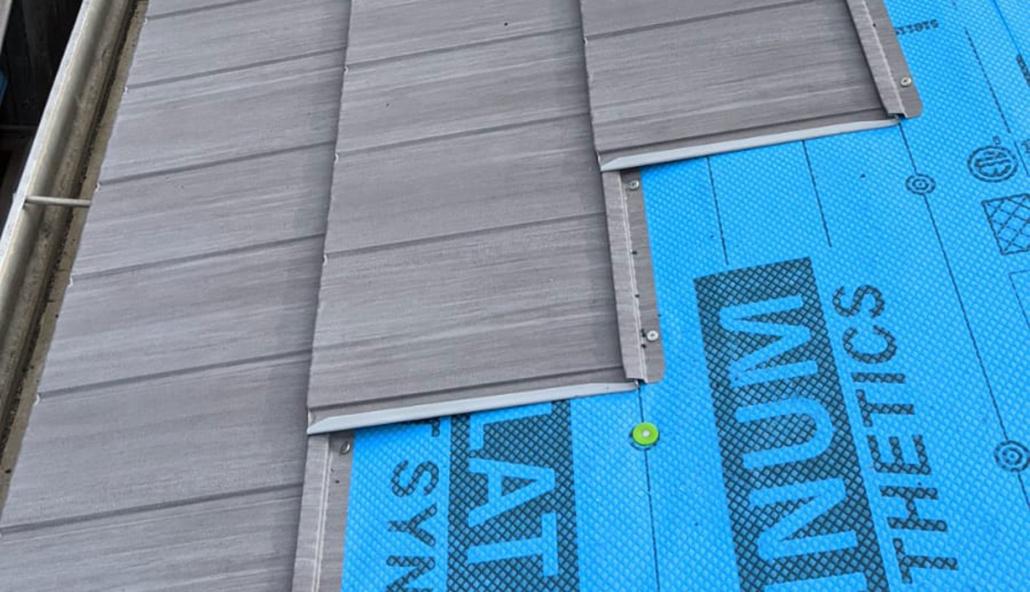
A concealed-fastener metal roof in Kitchener — the kind of system built to last 40 to 50 years.
The single biggest factor in lifespan isn’t the product — it’s the install
You can buy the best steel in the world and have it fail decades early if it’s installed poorly. The most common lifespan-killer I see is an over-reliance on caulking to keep water out from under the roofing. Sealant breaks down in the sun, dries out, and eventually has to be replaced — so a roof that depends on caulking is a roof on a maintenance clock from day one. A properly detailed install doesn’t need it.
Two installation mistakes will ruin a brand-new roof in a matter of weeks, not decades:
Sparks on the steel. Any tool that throws sparks landing on the painted steel will ruin the finish and have it rusting within weeks of the install. The right tools for cutting steel simply don’t do this.
Cutting galvanized or Galvalume sheets with a grinder. This destroys the protective coating right at the cut edge, and you’ll see rust appear within a few weeks. It’s one of the clearest signs a roof was put on by someone who doesn’t know metal.
On top of that, flashings, valleys, and gables done the fast, easy way instead of the right way will lead to maintenance and repairs down the road. The details you can’t easily see from the ground are exactly the ones that determine whether your roof reaches 20 years or 50.

A properly locked valley on a metal shingle roof in Kitchener. Details like this — not caulking — are what keep water out for decades.
Two roofs I’ll never forget
We’ve replaced a lot of exposed-fastener roofs well before the 30-year mark — often right around 20 years, because the screws have started to leak. The part that gets homeowners is what we find when we pull the sheets off: water has usually been getting into the house for far longer than they ever realized. There’s often severe water damage that has to be repaired before we can even put the new roof on.
The worst failure I’ve ever seen was a roof bought from a small manufacturer who was buying steel from overseas. It had a PVC-coated paint, and it lasted less than five years before the paint started coming off the steel in big sheets — literally flaking off. The homeowner had to replace a roof that should have lasted half a century. To make it worse, the manufacturer ended up filing for bankruptcy, so the homeowner was left on the hook for the whole thing.
A metal roof’s lifespan is only as good as the steel and the company standing behind it. Both of those stories were avoidable — and they point straight to the next question.
How to make sure you’re getting steel that actually lasts
I’ll be honest with you: this is a hard market for a homeowner to navigate. There are a lot of systems out there, and it’s genuinely difficult to verify where the metal is coming from. In the last 15 to 20 years there’s been a surge of small metal roofing manufacturers here in Southwestern Ontario, and a lot of them are buying offshore steel while telling homeowners it’s “all Canadian” or “North American” steel.
The easiest and best protection is to ask for products from a large, reputable manufacturer — the kind that’s been around and actually stands behind their warranties. That one step screens out most of the risk.
Paint systems: good, better, best
There’s a quality ladder on paint. SMP is the most common option for metal roofing, and PVDF is the best you can get installed right now. That said — don’t let anyone scare you into thinking SMP is what will cause your roof to fail. A quality product with SMP paint will still last 40, 50 years or more. PVDF is the premium choice, but SMP is a perfectly good one.
Steel coating
For galvanized steel, the coating weight is graded G50, G70, G90, and up — the number refers to how much zinc coating sits over the carbon steel core. For a home, I wouldn’t recommend anything less than G90. (Galvalume is measured a little differently and has its own pros and cons depending on the environment — that’s a big enough topic that it deserves its own post.)
Does our Ontario climate shorten a metal roof’s life?
Honestly? No. I don’t think our climate has anything that will wear out a metal roof faster than anywhere else. We get the full array of weather, and yes, UV and sun are hard on everything — they’ll deteriorate rubber flashings and caulking and wear the paint over time. But quality paint systems are tested for exactly this, so there’s no nasty surprise here. They last as long as they’re supposed to.
The one part of our climate that is genuinely tricky — and I want to be straight about this — is ice damming. A metal roof does not prevent ice damming, and addressing it and keeping leaks out of the house can be difficult on any roofing system, metal included. So if anyone tells you metal makes ice dams disappear, that’s not true. It’s the one local challenge worth planning for, no matter what’s on your roof.
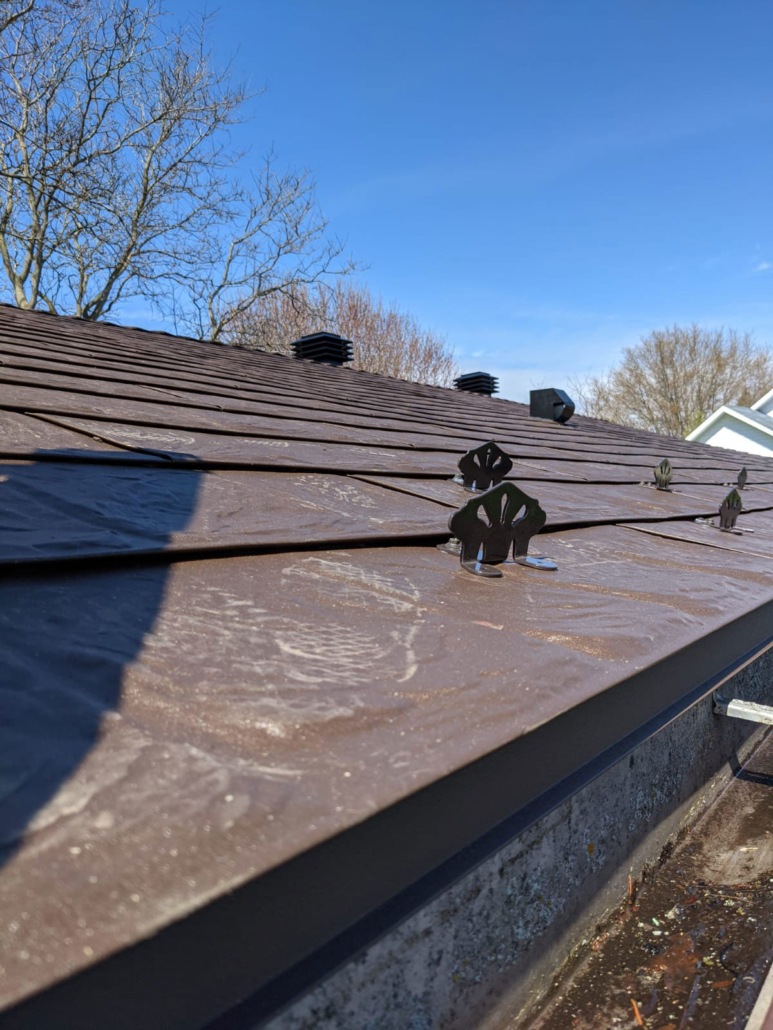
Snow guards on a metal roof in Wellesley. Metal sheds snow well — but managing winter still comes down to proper detailing, not magic.
Is metal really “install it and forget it”?
For the metal portion of the roof, there’s honestly nothing a homeowner needs to do to extend its life. It really is low-maintenance.
Could you repaint a metal roof in the field? You can — but it’s something you see far more in commercial and agricultural settings than on homes. And here’s the catch: once you start that cycle, you’re committed to redoing it every five to ten years, because field-applied paint won’t last anywhere near as long as the original factory finish.
As for shortening your roof’s life by accident — I really don’t see homeowners doing much that hurts a roof. Walking on it won’t shorten its life (unless you’re somehow punching holes through the steel). Washing it is fine, as long as you’re not using harsh chemicals that would peel the paint. For the most part, you can leave a quality metal roof alone and let it do its job.
What about the warranty?
Remember how I said the real lifespan is longer than the warranty? That’s worth understanding. Every manufacturer’s warranty is different, and for the most part they’re weaker than they look — there are enough loopholes in roofing warranties that the topic really deserves its own article. But here’s the honest shape of it:
A reputable manufacturer will usually give you a 30-to-40-year warranty on the paint, which covers how much it’s allowed to fade and chalk in that window. Then there’s the lifetime or 50-year warranty, which is essentially saying the roof won’t rust through to the point of a hole in the steel. The best products out there go further — non-prorated warranties that even cover the cost of installing a replacement roof if something goes wrong.
The thing to remember is that a warranty is only worth as much as the company behind it. Buy from a less-than-reputable manufacturer, and you’re betting they’ll still be around in 15 or 20 years if you ever need to make a claim — and as that bankruptcy story shows, that’s not always a safe bet.
The bottom line: what I tell homeowners in the driveway
When someone asks me point-blank how long their metal roof is going to last, here’s the honest answer I give:
If you go with an exposed-fastener or stone-coated system, expect somewhere around 15 to 20 years before it either needs replacing or a serious overhaul to swap out the parts that have aged.
But if you go with a concealed-fastener system — a 4-way locking steel shingle or standing seam — and it’s installed properly, I tell homeowners it’ll last 40 to 50 years, no problem. That’s the roof you put on once and don’t think about again.
So “how long does a metal roof last?” really comes down to two decisions: the system you choose, and the crew who installs it. Get both of those right, and you’ve bought yourself a roof that may well outlast your time in the home.

Standing seam on a low-slope roof in Waterloo — a concealed-fastener system built for the long haul. Advanced Metal Roofs.
Wondering how long your roof has left — or what would last on your home?
After 14 years on roofs across Southwestern Ontario, we’ve seen just about every system and situation imaginable. We’ll give you a straight, no-pressure assessment and a free quote.
Leave a Reply
Want to join the discussion?Feel free to contribute!