It’s one of the most common questions homeowners ask when considering a metal roof — and almost every answer online is written to sell you something. Here’s the honest version, based on what I’ve actually seen happen with real customers.

The Short Answer

Sometimes it goes down, sometimes it goes up, and sometimes nothing changes at all — it depends entirely on your insurer. Some companies raise the premium because a metal roof is more expensive to replace; others lower it for the added wind and fire resistance. When you do get a discount, it’s usually small.

The bigger insurance story isn’t the premium — it’s staying insurable. In 14 years I’ve never once seen an insurer threaten to drop a homeowner because their metal roof got old. I can’t say the same for asphalt.

In all the years I’ve been installing metal roofs across Southwestern Ontario, insurance is something that comes up far more before the job than after it. People want to know if the roof will pay them back in premium savings. It’s a fair question, so let me give you a fair answer — including the parts most roofers won’t mention.

It can go both ways — and most people only hear one side

Here’s the thing nobody tells you: a metal roof can actually raise your premium. I’ve seen it happen. The logic is simple once you hear it — a metal roof is a higher-ticket item than a standard asphalt shingle roof. If your house ever needs that roof replaced for any reason, the insurer is on the hook for a bigger payout. Some companies price that in and your premium goes up.

I’ve also seen it go the other way, where a homeowner’s premium dropped after switching to metal. So this isn’t a case of “metal always saves you money” or “metal always costs you more.” Every insurance company has its own policies, and they don’t all look at metal the same way.

Photo placeholder

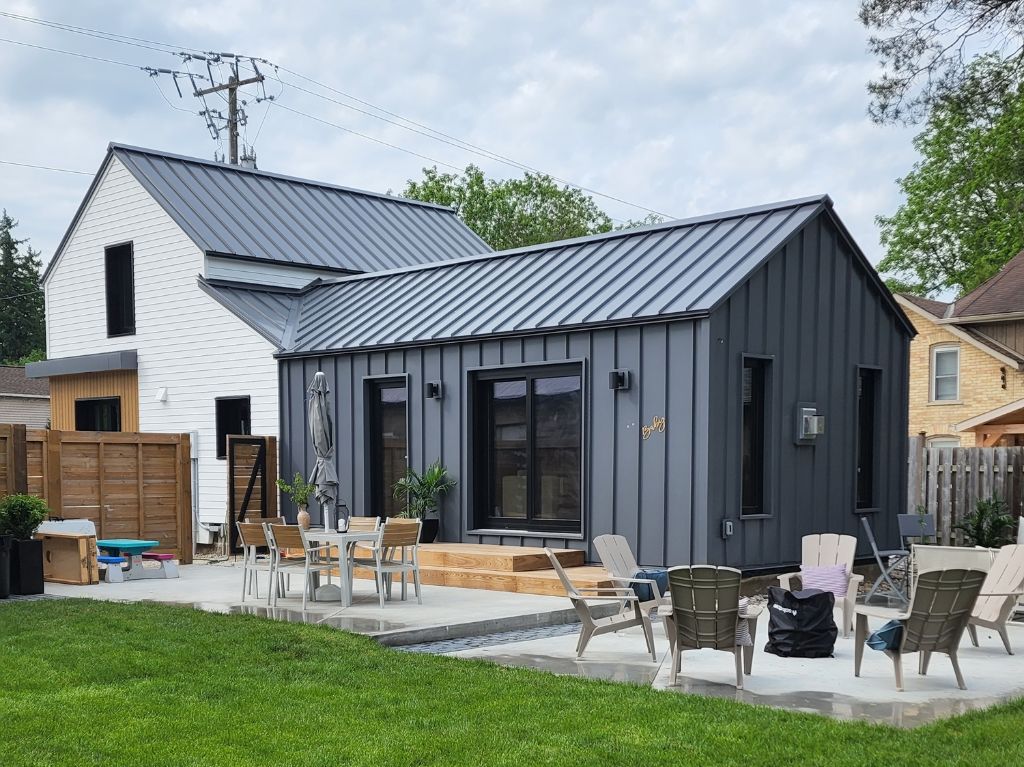
A clean finished metal roof project (standing seam or steel shingle) on a Southwestern Ontario home.

A finished metal roof on a home in our service area.

A real example: when the premium went up

This is exactly where my “it can go both ways” comes from. I had a homeowner call me after their metal roof was installed. Their insurance company had told them their premium was going up — specifically because they’d put on a metal roof, since it was a higher-ticket item than the asphalt shingles it replaced.

So what did they do? They shopped around. They found another provider who gave them a premium comparable to what they were paying before the metal roof went on. Problem solved.

That’s the practical lesson buried in this whole topic: if your current insurer raises your rate over a metal roof, you don’t just have to accept it. It might simply mean it’s time to shop your home insurance.

What insurers actually reward — and it’s mostly wind

When an insurer does lower a premium for metal, what are they really paying you back for? In our part of Ontario, the big one is wind.

A metal roof is far more wind resistant than asphalt — and here’s the part that matters most: it doesn’t lose that wind resistance over time. An asphalt roof is at its most wind resistant the day it’s installed. Twenty years later, it’s a shadow of that. A metal roof? It’s just as wind resistant in twenty years as the day it went on. That consistency is worth something to an insurer who’s thinking about the long game.

An asphalt roof is most wind resistant the day it’s installed. A metal roof is just as wind resistant in twenty years as it is today.

Fire is the other factor people bring up. We don’t have a wildfire risk in this area the way some regions do, so it’s less of a driver here. But it’s still real: asphalt shingles are saturated in oil, which makes a house light up faster. A metal roof isn’t combustible. In wildfire country, that matters a lot to insurers. Around here, wind is the headline.

What about hail? The Class 4 reality

Hail comes up a lot, but I’ll be straight with you — in our region it’s really not a concern. In 14 years of metal roofing, I’ve had exactly one insurance claim on a metal roof for hail damage, and that was a freak storm with hail we almost never see here.

Will metal dent? Yes. If you get hail an inch or more in diameter, it’ll dent metal roofing. Honestly, with hail that size, there isn’t much of anything that won’t get dented or damaged. So I’m not going to tell you metal is hail-proof, because it isn’t.

What metal does give you is integrity. Most metal roofing carries a Class 4 hail rating — the highest there is. Even after a severe hailstorm, the roof stays together and keeps the water out. You’re not dealing with leaks. Compare that to a tile roof, where you can end up with cracked tiles that need replacing immediately to stop water getting in. That one hail-damaged roof I replaced? It was still completely intact and watertight. It was just badly dented — a cosmetic problem, not a structural one.

Photo placeholder

A close-up of a metal panel or steel shingle profile showing the finish and seams — supports the durability/Class 4 point.

Quality steel holds its integrity even after a severe storm.

One thing to ask about: cosmetic damage exclusions

Here’s the flip side of that “dented but watertight” reality, and it’s worth knowing before you sign anything. Because metal dents without leaking, some insurers single metal roofs out for what’s called a cosmetic damage exclusion — sometimes offered as a waiver in exchange for a slightly lower premium. It does exactly what the name says: if hail dents your roof but doesn’t actually let water through, the insurer can decline to pay for it. In other words, the very situation I just described — a roof that’s badly dented but completely sound — is the one these clauses are written to exclude.

I’ll be careful here, because I can’t tell you exactly how every Ontario policy handles this. But it’s absolutely worth a direct question to your insurer: does my policy exclude cosmetic damage, and is there a waiver attached to any discount you’re being offered? A few dollars off your premium isn’t worth much if it quietly signs away your hail coverage.


So are the savings even worth chasing?

Let me be blunt, because this is where I think homeowners deserve the truth: I would not tell anyone to buy a metal roof to lower their insurance premium.

If you want to shop your insurance after going metal, sure — it might be worth looking into. But from everything I’ve seen, the savings aren’t drastic. They’re not the kind of number that changes your decision. If insurance premiums are the only reason you’re considering a metal roof, you’re looking at it from the wrong angle.

The bigger insurance story nobody talks about: staying insurable

Here’s the part that actually matters, and it’s not about premiums at all.

Insurers don’t just care what your roof is made of — they care how old it is and what condition it’s in. I’ve done plenty of roofs over the years for homeowners who got hit with an ultimatum: replace your roof within a certain window, or we’ll stop insuring your home. That’s a real thing that happens to aging asphalt roofs.

Now here’s what I’ve never seen, not once in 14 years: a homeowner calling to tell me their insurance company is dropping them because their metal roof is now 15 or 20 years old. It doesn’t happen. A quality metal roof takes you out of that cycle entirely. It keeps your home insurable, and it means you’re not being forced to tear off and replace a roof every couple of decades just to keep your coverage — even when the roof still looks great.

I’ve never seen an insurer tell a homeowner they have to replace their metal roof because it’s now twenty years old.

How to actually find out for your home

If you want a real answer for your specific situation, follow these steps:

Your steps

  • Call your insurer and ask directly. They’re the only ones who can tell you what a metal roof does to your specific policy. Be sure to ask whether your policy carries a cosmetic damage exclusion or waiver.
  • Get the system documentation from your installer. We can provide the details on exactly which system is going on your roof — including the hail-testing ratings and wind ratings. Send that to your insurer so they can make an informed decision about your premium.
  • Get any discount in writing before you commit. If your insurer says a metal roof will lower your rate, ask them to confirm the savings in writing rather than taking it as a verbal promise. That way you know exactly what you’re factoring into your decision.
  • Shop the same package around. Give that identical information to other insurance companies and see who offers you the best premium. If your current company raises your rate, another one may not.

So why get a metal roof, then?

If the honest answer is “don’t do it for the insurance,” then what’s the real reason? It comes down to peace of mind.

A quality metal roof is a permanent, maintenance-free system on your home. You’re not going to be the homeowner calling your insurer in a panic because shingles blew off, or a tile cracked, or there’s an immediate leak you need fixed before it ruins your ceiling. You’re simply not living with that worry. That — far more than a few dollars off your premium — is the reason to go metal.

Thinking about a metal roof?

If you’re weighing your options and want a straight, no-pressure answer about your home, we’re happy to walk you through it.

The short version: Both are excellent, concealed-fastener metal roofs that will outlast anything asphalt can offer. Standing seam is one continuous panel running to the peak, with the joint locked an inch or two above the roof. Steel shingles are individual pieces that hook together on all four sides.

If I ran both through identical torture tests, standing seam edges it as the top performer — but it’s a photo finish, not a blowout. For most homes the real decision comes down to three things: cost, which look you prefer, and whether solar is in your future.

I price both of these systems constantly, so I get this question in one form or another almost every week. Homeowners want to know whether one is genuinely better, or whether it’s just a matter of taste. The honest answer is a bit of both — so let’s put them side by side and go deeper than any spec sheet will.

First, one thing to get out of the way: when I say “steel shingle” in this article, I mean a four-way locking steel shingle. That distinction turns out to matter a lot, and I’ll explain why below.

How each one actually keeps water out

Strip away the looks and this is the real difference between the two systems.

Standing seam is vertical sheets running the full length of the roof, from eave to peak. The trick is where the joint sits: the seam between two panels stands up one to two inches above the roof surface, depending on the profile, and the panels lock together up there. So the seam — the one place water could get in — is raised well above where water actually runs and pools. Water simply never reaches the joint.

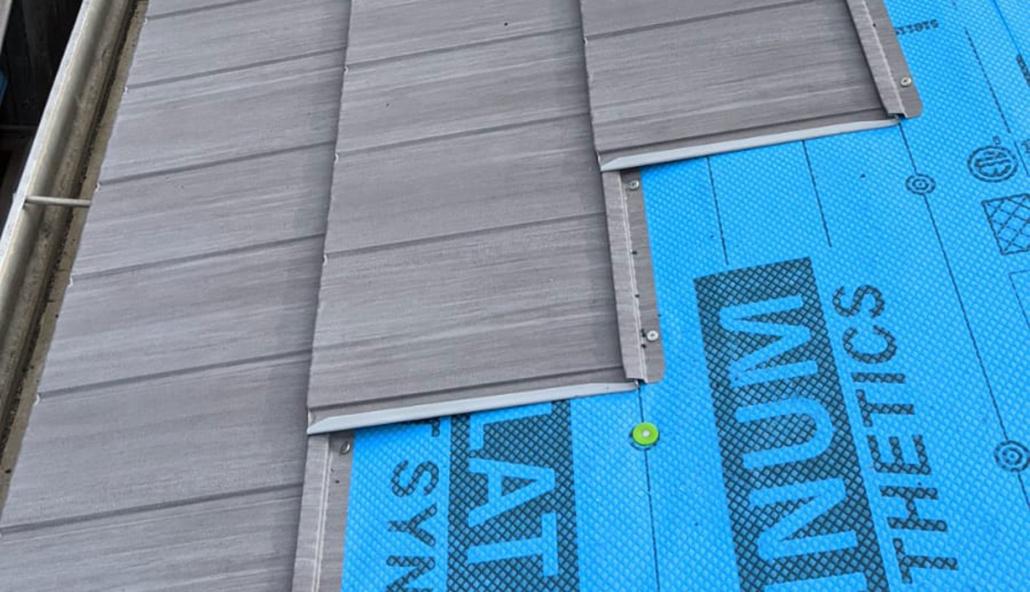
Steel shingles get to the same place by a completely different route. A quality shingle is hooked on all four sides, not overlapped. On the sides, one edge is bent up and the mating edge is folded a full 180° back on itself, so the two pieces hook completely together. The bottom edge is formed with a hook too, and that hooks onto a top lock on the shingle in the course below. Every one of the four edges is mechanically locked.

Locked valley detail on a grey four-way locking metal shingle roof in Kitchener, Ontario

A four-way locking steel shingle roof in Kitchener. The strength here isn’t any single shingle — it’s that every edge is hooked to its neighbours, not overlapped.

⚠ The catch with “steel shingles”

Not every shingle sold as a “steel shingle” is four-way locked. Some only lock top-and-bottom and just overlap on the sides. Some lock the sides and overlap top-and-bottom. And some just overlap on all four sides with exposed fasteners. Those are not the same product, and they will not perform the same way. This is the single biggest thing to get straight before you compare prices.

Standing seam raises the joint above the water. A four-way shingle hooks every edge. Both win by locking, not lapping — that’s the whole game.

Does one install better on a tricky roof?

Homeowners expect this to be a big differentiator, and honestly, it mostly isn’t. Both standing seam and four-way steel shingles can be installed on just about any roof feature out there — valleys, hips, dormers, chimneys, even round dormers. In fourteen years I can’t point to a roof shape and say “that one needs shingles” or “that one needs standing seam” on the basis of complexity alone.

There’s one practical wrinkle worth knowing. Standing seam panels come as full-length pieces — sometimes twenty-plus feet. Getting those to where they need to go can be the harder part of the job on a tight site. Shingles come in manageable individual pieces. It’s a logistics point, not a performance one, but it’s real.

The other place the two diverge is accents. When someone wants metal on just a porch, portico, or turret, that’s almost always standing seam — steel shingles rarely play the accent role.

Which handles winter better?

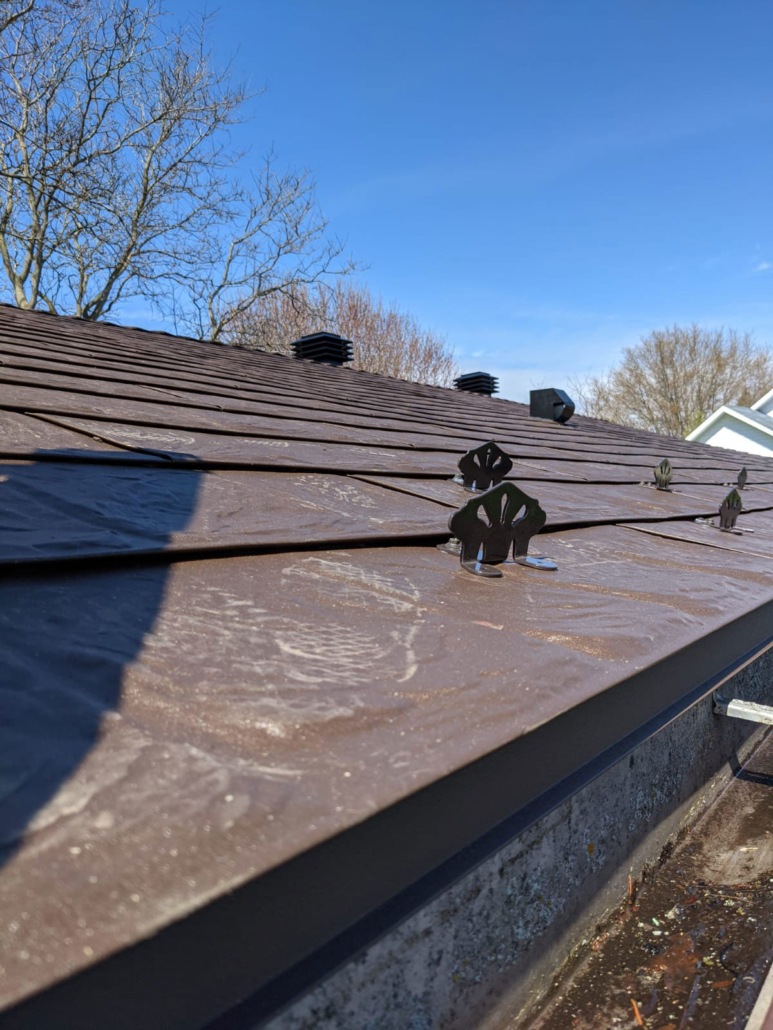
For most of what a Southwestern Ontario winter throws at a roof, these two are dead even. Both shed snow and ice quickly — no meaningful difference there. And both need snow guards where you’re protecting a walkway, a door, a driveway, or anything below the eave from a sudden slide. That requirement is the same for either system.

Snow guards installed on a brown metal shingle roof to control snow shedding

Snow guards on a metal shingle roof. Both systems shed fast and both need snow retention where people or property sit below.

The one edge goes to standing seam, and it’s the same edge that shows up everywhere else in this comparison: ice damming. Because standing seam can run on a much lower slope and is the more waterproof system when water backs up and sits behind an ice dam, it holds up better in the areas most prone to that. If you’ve got a stubborn ice-dam spot, that’s a point in standing seam’s favour.

What each costs — and exactly why

On new construction, the two systems price out pretty close. On a reroof, standing seam usually costs meaningfully more — and the reason is worth understanding, because it’s almost entirely about prep, not the metal itself.

A standing seam panel is flat, and it sits directly on the substrate. That means any unevenness underneath — the ridges and valleys of old shingles, a wavy deck — telegraphs right through that flat face and shows. So to run standing seam on a reroof, we either tear the old shingles off, or we double-strap and shim the roof to build a dead-flat plane, and add high-heat ice-and-water underneath. That’s real labour.

Steel shingles are formed, three-dimensional pieces that don’t lie flat against the deck. Their profile hides what’s underneath — so even with old shingles still down, the imperfections don’t show through the new steel. Less prep, lower labour, lower price.

✓ Where your money actually goes

Material costs between the two are essentially the same. The reroof price gap is almost pure labour — the prep to get standing seam a much flatter surface to sit on. Could you lay standing seam right over old shingles to save that? Functionally, yes — but imperfections are more likely to show through, so when you’re pricing this out, it’s a good idea to make sure you’re comparing apples to apples between quotes.

Down the road: repairs and modifications

Say it’s fifteen years from now and a branch comes down, or you want to add a skylight. Can these be fixed? Yes — both of them, right in the middle of the roof. But I’ll be straight with you: it’s never fun. Nobody looks forward to opening up a finished roof, on either system.

Here’s the wrinkle most people don’t expect: ease of repair tracks the specific system, not just the standing-seam-vs-shingle category. Among standing seam, snap-lock is actually one of the easiest roofs to swap a panel on in the field — a genuine advantage it has over mechanical-lock standing seam, which takes more work to open up. And among shingles, the metal matters: an aluminum shingle comes out far more easily than a steel one. So “which is easier to repair?” doesn’t have a clean category winner — it depends on the lock type and the material.


So… is one of them just better?

People ask me this directly, and they almost always follow it with: “What do you have on your property?”

The answer: I have both — on my shop. It’s got metal shingles, with a substantial standing seam accent on the shed dormer. I didn’t crown one winner even there — I used each where it made the most sense. That’s not a dodge; that’s the honest reality of how good these two systems are.

But if you truly corner me and say “rank them” — if you ran both products through every identical test to see which failed first — I believe standing seam is probably the top-performing metal roof, and would likely outlast the shingle in more categories. I want to be clear about the size of that gap, though: it’s a photo finish. Steel shingles hold up great, with essentially no real-world problems. These are two excellent roofs — not one good one and one bad one.

Black 24-gauge standing seam metal roof with clean concealed-fastener detailing on a Cambridge home

Standing seam on a Cambridge home. If forced to rank raw performance, it edges ahead — but it’s a narrow margin over a shingle that performs excellently in its own right.

The honest case for steel shingles

Since I gave standing seam the slight nod on paper, let me make sure the shingle gets a fair shake — because there are real, informed reasons to choose it.

The biggest one is the look, and it’s more than personal taste. A lot of homeowners look at standing seam and see a barn or an agricultural building — those vertical panel lines could also read “industrial” to them, and they don’t want their home to look that way. This is exactly where steel shingles shine: they give you a permanent, four-way-locked metal roof that doesn’t look like metal at all — it reads as a traditional shingle or shake. For the right house and the right homeowner, that’s the deciding factor, full stop.

On top of the look, you’ve got the two practical wins from earlier: on a reroof they usually cost less, and their profile hides an uneven deck that standing seam would put on display. So steel shingles aren’t a fallback. On the right house, they’re the smarter choice.

There’s one more honest point in the shingle’s favour: oil canning. Every standing seam roof oil-cans to some degree — that slight waviness you can catch across a flat panel in certain light. To be clear, it’s a natural characteristic of standing seam, not a defect, and we spell that out in writing on our contracts so nobody mistakes it for a flaw. But steel shingles essentially don’t oil-can, because the stamped profile breaks up the flat plane where it would show. If a perfectly smooth-looking roof matters to you, that’s a real mark in the shingle’s column.

How the decision actually gets made

When someone’s genuinely on the fence — same house, could go either way — the decision almost always lands on one of three things.

If this is your priority……here’s where it points
Cost, especially on a reroof Steel shingles usually come in lower, because they skip the tear-off / strap-and-shim prep standing seam needs.
The look you love Pure preference. Clean modern vertical lines → standing seam. Traditional, non-industrial, “doesn’t look like a barn” → steel shingles.
Future solar Standing seam. Solar mounts to the seams with clamps that grip the panel — no holes drilled through the roof — where a shingle roof has to be penetrated to mount. If solar is anywhere in your plans, that tips the scale.
Raw, on-paper performance Standing seam by a hair — but both are excellent, so this rarely decides it on its own.

How to tell a quality install from a cheap one

This is the part I most want you to take away, because the difference between a roof that lasts 40–50 years and one that disappoints is usually the install, not the product name on the quote. Here’s what to ask and watch for on each system.

On standing seam: no exposed fasteners — anywhere

The entire point of standing seam is concealed fasteners. So the red flag is exposed fasteners where there should be a lock. I see homeowners who bought a “standing seam” roof that still has screws driven right through the panels — usually at the drip edge (where the panel should have a lock bent on the bottom and hooked onto the drip edge, instead of being run long and screwed through the face), and often at gables and valleys too.

Those are the most vulnerable areas on the whole roof — the bottom edge and the valleys, where water concentrates. A screw through the panel there defeats the purpose of the system. Ask any standing seam installer directly how they finish the eaves, gables, and valleys. The answer should be locks, not screws.

On steel shingles: confirm it’s four-way locking

Because “steel shingle” covers such a wide range of products, make sure you’re comparing like for like. A dramatically cheaper shingle quote is often the tell that it’s not a four-way lock — it might lock only top-and-bottom, only the sides, or just overlap on all four sides with exposed fasteners. Ask the question plainly: is this a four-way locking, concealed-fastener shingle? If it isn’t, that price difference isn’t a deal — it’s a different, lesser product.

⚠ The one I’d avoid entirely

Stone-coated steel shingles — steel with asphalt-style granules glued on — look great when they’re new, but they won’t make fifty years without badly deteriorating, the same way asphalt streaks and sheds its granules. In fourteen years I’ve never installed one and never will. I consider it one of the worst metal roofing products on the market.


The bottom line

Here’s how I send homeowners off. Drive around. Look at different roofs and different styles. Find the ones you actually love on real houses. And take your time with it — a metal roof is going to be up there for a very long time, so it’s not a decision to rush.

Because at the end of the day, both a true standing seam roof and a four-way locking steel shingle are going to be a great choice for most homes. Get the install right, pick the look you love, and you genuinely can’t go wrong between these two.

Don’t rush a fifty-year decision. Between a real standing seam and a four-way locking shingle, there’s no wrong answer — just the one you’ll love pulling up to.

Still torn between the two?

Tell us about your roof and what you’re picturing. We quote both systems side by side, honestly — and we’ll flag anything you should know before you decide.

If you search “questions to ask before hiring a metal roofing contractor,” you’ll find a dozen articles that all say the same five things: check the license, check the insurance, ask about experience, ask about warranties, get it in writing. None of it is wrong. But most of it is written for a homeowner in Texas, and almost none of it tells you the things that would actually catch a contractor who doesn’t really know metal.

I install metal roofing for a living — only metal, nothing else — and I’ve spent more than a decade on roofs across Southwestern Ontario. What follows isn’t a list of safe, generic questions. It’s the questions I’d want my own family asking if they were getting quotes tomorrow, the ones that tell you whether the person across your kitchen table is there to put the right roof on your house or just to land a sale.

One honest thing before we start: no list of questions can fully protect you. A smooth salesperson can say all the right things. But the right questions stack the odds heavily in your favour, and a few of them will flush out a pretender in about thirty seconds.

Photo placeholder

A strong, finished hero shot — a completed standing seam or steel shingle roof on a local home, ideally a wide angle that shows the whole roofline.

Lead image — your best completed-roof photo sets the tone for the whole article.

Question one

Will you actually come out and inspect my roof — including the attic?

There’s good technology now for measuring a roof from satellite imagery, and we use it ourselves for ballpark numbers. But a measurement off Google Earth is not an inspection. It tells you the size of the roof. It tells you nothing about the condition of what’s under your shingles, or whether your attic is ventilated properly.

That second part matters more than almost anything else on this page. We’re putting on a roof that can last fifty years or more. Before we commit to something that permanent, we need to know the substrate is sound — the substrate being the sheeting (or decking) that your roof is built on, the wood layer your shingles are fastened to and that everything above it depends on. That means checking there’s no rot hiding in that sheeting, no active leak, no severe mould, and no structural problem underneath. And most homes, even before they were last shingled, were never ventilated correctly. A metal roofer who doesn’t go into your attic is guessing about the very thing your roof’s lifespan depends on.

A straight answer sounds like

“We’ll use satellite for a ballpark, but a project manager comes out to verify on site, and we always do an attic inspection to check the roof’s condition and your ventilation before we quote a permanent product.”

Walk away if

They want to quote the whole job off a satellite measurement and never set foot on the property — or they skip the attic entirely. That’s a sign they’re chasing a commission, not protecting your home.

Photo placeholder

One of your crew doing an attic / ventilation inspection, or a project manager up on a roof verifying measurements in person.

Drop in a real inspection photo — it proves the point better than any words.

Question two

What steel are you installing — and can you tell me its coating and paint system?

This is the fastest test there is. Ask a contractor whether their steel is galvanized or Galvalume, and ask how much coating is on it. A professional metal roofer will know without hesitating — they’ll tell you whether it’s G70 or G90 galvanized, they’ll know the paint system on it, and they’ll know why those things matter. Someone who installs metal as a sideline usually can’t, because to them steel is just steel.

Why dig into this? Because where the steel comes from changes everything. A supplier importing cheap offshore steel can come in well under everyone else on price — and that steel can be a lower grade that causes problems down the road. The coating and the paint are what determine whether your roof is still doing its job in forty years or fading and failing in fifteen.

A straight answer sounds like

They name the coating (e.g. G90 galvanized or Galvalume), explain the paint system, and can tell you where the steel is made — comfortably, in plain language.

Walk away if

They don’t know the difference between galvanized and Galvalume, can’t tell you the coating weight, or get vague about where the steel comes from.

Photo placeholder

A close-up of the steel itself — a coating stamp / G90 marking, a bundle of panels, or a colour/paint sample fan.

A shot of the actual product reinforces that you know exactly what you’re installing.

Question three

What underlayment goes under the metal?

Here’s another quick one that tells you a lot. Best practice is always to install an underlayment beneath the metal — but with a metal roof it has to be a high-temp product, either a high-temp synthetic underlayment or a high-temp ice-and-water shield. Metal gets hot, and standard underlayment isn’t built for it.

A contractor who’s fluent in metal will bring this up themselves. If you ask and you get a blank look, or they treat underlayment as an afterthought, that tells you how familiar they really are with the product.

A straight answer sounds like

“A high-temp synthetic underlayment or high-temp ice-and-water shield over the deck — standard underlayment isn’t rated for the heat under metal.”

Walk away if

There’s no underlayment in the plan, or they’d use a standard product not rated for the temperatures a metal roof reaches.

Question four

How will you finish the edges, the valleys and the gables?

This is where the real craftsmanship — and a lot of the cost — lives, and it’s where cheap quotes quietly cut corners. With steel shingles and standing seam, the right way to finish is to lock the ends of every sheet: at the drip edge, at the rakes and gables, and into the valleys. That takes specialty tools and a lot more labour.

The shortcut is to run the panels into J-trim instead, or to screw the ends down, or to run shingles to the centre of a valley and cap over the cut edges. It’s faster, it’s cheaper, and it’s not the same roof. Bending a lock on every shingle and locking it into a valley is what separates a roof that stays maintenance-free from one that gives you trouble later.

You don’t need to become a roofing expert to use this. Just ask how they handle the gables and valleys, and listen for whether they talk about locking the panels or trimming them in.

A straight answer sounds like

They describe locking the ends of the panels at edges and valleys, and they have the tools to do it. They can explain why it costs more — and why it’s worth it.

Walk away if

The plan is J-trim everywhere, screwed-down ends, or shingles run to the centre of the valley with a cap — especially if it’s paired with no strapping and no underlayment over the old roof.

Photo placeholder

A clean locked valley or gable detail from one of your installs — ideally next to (or instead of) a J-trim job for contrast.

A close-up of a properly locked valley makes this section land instantly.

Question five

Who’s in charge of quality control, and will they be on my roof?

People love to ask whether a company uses its own crews or subcontractors, as if one is automatically better. In my experience, it doesn’t decide whether the job gets done right. I’ve seen excellent work and sloppy work from both. An in-house crew is no guarantee of quality control, and a good subcontractor can be outstanding.

The better question is: who is responsible for the quality of the installation, will that person be on site, and who do I call if something goes wrong during the job? That’s what actually protects you. A company that can answer it clearly has thought about accountability. A company that can’t is hoping you don’t ask.

A straight answer sounds like

A named person owns quality control, they’ll be on or checking the site, and you’re given a direct contact for any issue mid-project.

Walk away if

Nobody can tell you who’s accountable for the install, or who you’d even call if a problem came up halfway through.

Question six

Can I see every warranty in writing — material, workmanship, and components?

When two quotes both say “warranty included,” they can mean wildly different things. There are actually three layers of warranty on a metal roof, and salespeople usually only mention one:

The material warranty

Covers the product itself — the steel and its finish. Ask for it in writing.

The workmanship (installation) warranty

This is the one people gloss over, and it’s critical. The installation warranty says that if something fails during the warranty period because the installation was wrong, the contractor will come back and fix it. Picture a chimney or a skylight that was flashed badly and starts to leak. That’s not a material failure, so it isn’t a material-warranty claim — it’s an installation failure, and the workmanship warranty is what covers it. Here’s the part to remember: if the installation warranty isn’t written into your contract, it’s worth nothing at all.

The component warranties

Almost nobody brings these up. Your vents, your caulking, your screws — these components carry their own separate warranties that rarely get mentioned when a salesperson is sitting in your living room. Ask about them.

What to actually ask for

Get the material warranty in writing, get the installation warranty written into the contract, and ask what the separate component warranties are. If a contractor can’t or won’t put the installation warranty in writing, treat it as if it doesn’t exist — because legally, it more or less doesn’t.

Question seven

Are you WSIB-covered, properly insured, and certified to work at heights?

This is the boring paperwork that becomes a nightmare when it’s missing — and in Ontario, some of the responsibility quietly lands on you, the homeowner. Three things to confirm, and ask for proof on each:

WSIB. Contractors are issued a WSIB clearance certificate, and you’re entitled to ask for it. Don’t just take the certificate — the clearance number can be verified on the WSIB website, so check it. This matters because under Ontario’s Workplace Safety and Insurance Act, the person hiring a contractor for construction work is responsible for making sure that contractor is registered and paid up.

Liability insurance. Every contractor working on your home should carry an active liability policy, and they should be able to hand you written proof of it. If your roof gets opened up, the rain comes, and your home takes serious water damage, that policy is what stands between you and a bill the contractor may not be able to pay out of pocket.

Working at heights. In Ontario, workers on a construction project who could fall three metres or more and use fall protection must hold valid working-at-heights training. Here’s the part homeowners don’t realize: if you hire several trades to work at once, OHSA can treat you as the “constructor” — which can make you responsible for everyone’s safety and compliance on your property. Hiring one contractor who acts as the constructor, and who can show their crew is trained and insured, is what keeps that liability off your shoulders.

The bar we hold ourselves to

For what it’s worth, this is exactly the standard we meet on our own jobs: our installers are working-at-heights certified, WSIB compliant, and we carry liability coverage up to $5M. It’s not a sales line — it’s the minimum a homeowner should be able to verify before anyone climbs a ladder.

Photo placeholder

Your crew working safely — harnesses / fall protection and a tidy, well-set-up job site. This visually backs up the whole safety section.

A real working-at-heights shot proves the safety standard rather than just claiming it.

A note on “is your company licensed?”

Those US articles will tell you to demand a contractor’s license and check it for violations. In Ontario there’s no provincial roofing trade license, so that advice doesn’t really apply here. What you can verify is real: WSIB clearance, an active liability policy, working-at-heights certification, that they’re registered to charge HST, and that they hold any municipal business licence your area requires. Ask for the things that actually exist in Ontario, not the ones a checklist from another country tells you to.

Question eight

Who can vouch for your work?

Any contractor should be perfectly comfortable giving you references. For a purchase this size, ask — and how they react to the request tells you something on its own.

Here’s a twist most homeowners don’t think of: ask for references from different kinds of clients. A homeowner reference is fine, but most homeowners aren’t well versed in how roofing is supposed to go. If the contractor has worked with builders or other trades, ask for one of those references too. Someone who works in the trades can judge the quality of the work in a way you can’t — and they’ll tell you straight.

A straight answer sounds like

They readily offer references — and can point you to a builder or trades contact, not just past homeowners.

Walk away if

They’re cagey about references, or can only show you stock photos rather than their own completed local work.

Question nine

What does your deposit and payment schedule look like?

Deposits cause some heartburn, so let me be transparent about ours and why. If a homeowner isn’t financing the roof, we take one third on signing the contract, one third when we begin, and one third on completion. Some people don’t love it; most understand it once it’s explained. We take those protections so that we’re not holding the whole bag if someone decides not to pay at the end. That’s a structure you can use as a benchmark against other quotes.

What should make you nervous is the opposite: a contractor demanding a very large chunk of the total up front. There’s no good reason for it, and it leaves you exposed.

A straight answer sounds like

A staged schedule (such as thirds), explained plainly, with what’s included spelled out in the contract.

Walk away if

They want a large share of the total before the job even starts.

Question ten

Does the price actually make sense?

This is the one I’d tattoo on a homeowner’s hand if I could. I’ve seen it over and over: if a metal roof quote isn’t costing at least roughly twice what you were quoted for asphalt, you are almost certainly not getting a roof that’s installed to last. I’ve never seen a metal roof installed properly for less than about five or six dollars a square foot. Below that, you didn’t get a deal — you got a roof that won’t be maintenance-free, and you’ll be replacing it before the paint even wears out.

When one quote comes in dramatically cheaper than the rest, there are really only two explanations, and usually it’s both: the steel is cheaper (often imported and lower grade), and the labour is cheaper because the details are being cut — the locked edges, the valleys, the strapping, the underlayment. Remember that the majority of a metal roof’s cost is still the labour. A rock-bottom labour number isn’t a bargain; it’s a preview of where the corners will be cut.

A metal roof that costs less than about twice your asphalt quote isn’t a deal — it’s a roof you’ll replace before the paint wears out.
The single most useful number in this article

Understanding why a proper metal roof costs what it does — how the labour, the gauge, and the paint system add up — is worth a closer look on its own. But the short version is the number above: if a quote falls well below that floor, the savings are coming out of the steel, the details, or both.


And once you’ve hired: what a good job actually looks like

A few things that aren’t exactly questions, but are worth setting expectations on before the work starts. A professional crew shows up when they said they would and puts in a full day, every day the weather allows. They protect your property — landscaping, gutters, what’s below the work — keep the site tidy as they go, and do a magnetic nail sweep so your driveway and lawn aren’t a hazard afterward. And at the end, a good contractor walks the perimeter of your home with you to answer any questions and address concerns before they pack up.

Photo placeholder

A tidy, well-run job site — or the project manager doing the final perimeter walkaround with a homeowner. Something that shows the job done right, start to finish.

An in-progress or finished-walkaround photo closes the article on professionalism.


The one thing underneath all of this: consultant, or commission?

If you strip away every question above, they all point at the same thing. The difference between a contractor who’s genuinely there to help you and one who’s just there to close a sale comes down to whether they take the time to understand your home and your goals.

A real metal roofer’s job is closer to a consultation than a pitch. We’re there to educate you on the options, learn what you’re hoping to achieve, and then point you toward the products that fit — not to push the one product we’re most eager to sell. So watch how the conversation goes. If a salesperson opens with “who else did you get quotes from?” and then spends most of the visit explaining why everyone else’s product is junk instead of talking about their own, I’d steer clear. If they never inspect the home, that’s commission-chasing. And if they can’t walk you through how the roof actually gets installed — or clearly don’t understand it — you may be talking to someone who was hired because they can talk well, not because they can roof well.

At the end of the day, it’s genuinely hard to know for certain. A good talker can say all the right things. So use these questions, lean on references — especially from the trades — and trust your gut.

An honest caveat

I’ll be straight with you: not every bad outcome is something a homeowner could have prevented with the right question. I’ve seen steel shingles installed on slopes shallower than 4:12 where the product never belonged, snow guards left off or installed wrong, and roofs thrown on the fastest way possible that go on to leak. When a salesperson sells someone a product that doesn’t suit their home just to earn the commission, that’s on the salesperson, not the homeowner. These questions tilt the odds strongly in your favour — but the real burden is on contractors to act in your interest. The good ones do.

Get a straight answer from people who only do metal

Free, no-pressure quote — including an on-site visit and attic inspection — across Kitchener, Waterloo, Cambridge, Guelph, London and the wider 519.

If you’re weighing a metal roof against asphalt shingles, there’s one thing I want you to understand before we get into anything else: a quality metal roof is going to cost more money than an asphalt shingle roof. That’s the honest starting point, and everything else in this comparison flows from it.

I’ve spent the last 14 years doing nothing but metal roofing, and before that I was installing asphalt shingles. So I’ve stood on both kinds of roofs, in every season we get here in Southern Ontario, and I’ve watched how both materials age over time. This isn’t a sales pitch. It’s what I’ve actually seen in the field — including the times asphalt makes sense and the myths about metal that just aren’t true.

Black standing seam metal roof installation in Cambridge, Ontario by Advanced Metal Roofs

Black standing seam installation in Cambridge, ON — Advanced Metal Roofs.

Let’s start with the hard truth: metal costs more

I’d rather get this out of the way first than dance around it. If you want a quality metal roof, you’re going to pay more than you would for asphalt shingles — and there are a few different things stacking up to make that true.

The material itself costs more. Asphalt shingles are going to run you somewhere around a third of the cost of metal roofing, or even less. That’s a big gap, and it’s the first thing people notice when they start getting quotes.

You’re paying for a lot more labour. Roofing an average house with asphalt shingles is a lot faster than doing it in metal. A metal roof is far more man-hours. So you’re not just paying for more expensive material — you’re paying for the additional time and skill it takes to install it properly.

And there are specialty tools involved. A proper metal install requires equipment that an asphalt crew simply doesn’t need. Those tools, and the know-how to use them, are part of what you’re paying for.

So when you see that higher number on a metal roofing quote, that’s where the money is going. It’s not arbitrary. It’s more material cost, more labour, and the specialized work that goes into doing it right.

So what are you actually getting for that extra money?

Here’s the other side of the ledger — and this is where my 14 years really shape how I see it. When you invest in a quality metal roof, what you’re buying is peace of mind. Peace of mind that your roof is going to hold up to all the harsh weather we get, and that you’re not going to be calling somebody out to patch it.

If it’s a quality metal roof — quality paint, installed properly — you’re looking at a maintenance-free roof for 50-plus years. No babysitting it. No service calls. No wondering whether this is the year it finally starts leaking. That’s a fundamentally different ownership experience than an asphalt roof, and it’s the heart of why people make the switch.

A quality metal roof, installed properly, is a maintenance-free roof for 50-plus years. That’s the payoff for the higher price.

Where metal really pulls ahead: the weather

People expect me to say metal wins on every weather front. The honest answer is more specific than that, and the headline is wind.

A quality metal roof installed properly has a much higher wind rating than an asphalt shingle roof. But here’s the part that really matters, and the part most comparisons skip over entirely: that wind rating doesn’t decrease over the life of the roof. An asphalt shingle’s wind resistance does. As shingles age, they get more vulnerable to wind — but a properly installed metal roof holds its wind performance for its entire life. That’s a huge difference when you live somewhere that gets the wind events we do.

There are also metal roofing options that stand up better to ice damming and the problems that come with it, and metal’s smooth surface sheds snow more readily than a shingle roof. But if I had to name the single biggest weather advantage metal has over asphalt, it’s wind — and the fact that the advantage doesn’t fade as the roof gets older.

Grey standing seam metal roof installation in Waterloo, Ontario

Standing seam installation in Waterloo — built to hold its wind rating for the life of the roof.


How an asphalt roof actually ages (the part you don’t see from the ground)

To really understand this comparison, it helps to know how an asphalt shingle is built and what happens to it over time. I see it up close on roofs all the time, but a homeowner standing on the ground never does.

An asphalt shingle is built on a mat — that’s the base of the shingle, made of fiberglass. There are oils in that original mat. Then on top of the mat they apply the granules — the coloured granules everybody sees on the surface of the shingles.

What happens around the 10 to 15 year mark is those granules start to come off. You’ll start seeing more and more of them in your eavestroughs, washing down your downspouts. That’s the sign. That’s the last breath of your shingles. And once they start to deteriorate, it usually speeds up significantly.

Granule loss isn’t the only signal, either. As shingles reach the end of their life, they also start to curl and delaminate. So between the granules in your eavestrough and the curling on the roof, those are the visible signs that an asphalt roof is on its way out.

  • Granules in the eavestroughs and downspouts — the protective surface is wearing off, usually starting around year 10 to 15.
  • Curling and delamination — the shingles themselves are breaking down and lifting.
  • Accelerating decline — once it starts, it doesn’t hold steady. It gets worse faster.

Compare that to metal, which doesn’t shed a protective surface the way asphalt does. There’s no granule layer to wear away, no mat to delaminate. That’s a big reason the maintenance-free lifespan is so different between the two.


Energy efficiency: two things most people don’t realize

Metal roofing helps with energy efficiency in a couple of different ways, and it’s worth understanding both because the second one tends to get missed entirely.

First, the paint. There are different paint systems out there, and they affect how much UV radiation and solar reflection you get off the roof. A quality reflective finish bounces more of the sun’s energy away instead of letting it soak in.

Second — and this is the one people overlook — the way a metal roof is formed. Because of its profile, a metal roof isn’t sitting flat and tight against the roof deck the way shingles do. That creates an air space between the metal and the deck, and that air space stops heat from transferring directly down into the attic. The result is a cooler attic, which helps with your cooling costs in the summer months.

So it’s not just “metal reflects heat” like you’ll read everywhere else. There’s the reflectivity of the coating, and there’s the air gap from how the roof is built — a structural advantage that has nothing to do with paint at all. Both work in your favour through our hot Ontario summers.

Black standing seam metal roofing and siding in Guelph, Ontario by Advanced Metal Roofs

Black standing seam roofing and siding in Guelph, ON — Advanced Metal Roofs.


Who actually comes to us for metal

Most of our customers have already had numerous experiences with asphalt roofing. They’ve had it on their house — sometimes more than once — and they aren’t happy with how it performed or how it aged. They’re frustrated that they have to do it again.

That frustration is the throughline for the majority of the people we work with. The other big group is people building new custom homes who simply don’t want to be redoing their roof every 15 to 20 years. They’re thinking long-term from the start, and they don’t want a roof that puts them back in the shopping cycle a decade down the road.

Both groups are really telling me the same thing: they’re tired of the asphalt cycle, and they want out of it.


So when is asphalt actually the right call?

From a performance standpoint, there’s almost no application where asphalt suits a roof better than metal. So the honest answer really comes down to one thing: budget. If a metal roof doesn’t fit yours right now, asphalt is a perfectly reasonable choice, and there’s nothing wrong with that.

The one reason I’d push back on is the one I hear most: “I’m not staying in the house long enough to justify metal.” A metal roof adds resale value in a way an asphalt roof doesn’t, so that argument is weaker than it sounds. But if it comes down to dollars and metal isn’t in the cards today, asphalt will still put a solid roof over your head.


Common myths about metal roofs

After 14 years, there are a handful of misconceptions I find myself correcting over and over. If you’ve been hesitant about metal because of any of these, let me clear them up.

Metal roofs make your house look like a barn.

If someone hasn’t looked into metal roofing, they often picture sheet steel or barn steel — and understandably, they don’t want their house to look like a barn. But that’s outdated. There are a lot of different styles of metal roofing out there now, including products that look like shingles, slate, or shake. Your house does not have to look like a barn.

They’re noisy in the rain.

On a typical house — where you’ve got ceiling insulation and an airspace above the insulation — you’re most likely not going to hear average rain inside the house with your windows closed. In a heavy rain, you’ll hear it inside whether you have asphalt shingles or metal. The idea that a metal roof turns every rainfall into a racket inside your home just isn’t accurate for normal house construction.

Metal roofs attract lightning.

They don’t. Lightning is attracted to the highest point. If your house is up on a hill, it can get struck no matter what’s on the roof — metal or not. The roofing material isn’t what’s drawing the lightning in.

You’ll dent it just walking on it.

This one depends heavily on the product. Some are easier to walk on than others. With some products, a dent can compromise integrity — but with others, a dent doesn’t affect performance at all. And a lot of these products are very textured, so even if there’s a minor dent from someone walking on the roof, you can’t see it from the ground.


The bottom line after 14 years

Here’s my honest opinion, plain as I can put it. A metal roof might be the right choice for you if:

  • You don’t want to deal with service calls on your asphalt shingles.
  • You don’t want the hassle of shopping for a new roof every 15 to 20 years — something most people don’t get excited to shop for.
  • You’re looking to make an environmentally friendly choice — a product that can be completely recycled at the end of its life, rather than asphalt shingles, which will almost certainly end up in a landfill.

If those things matter to you, and a metal roof fits your budget, then in my experience it’s the better roof — and it’s not particularly close. The higher upfront cost buys you decades of not thinking about your roof, better performance against the weather we actually get here, and a material you can feel good about. That’s the trade I’d make every time.

A note on installation: What separates a quality metal install from a poor one is a big topic in its own right — important enough that it deserves its own article rather than a few rushed lines here. I’ll be covering how to vet a metal roofing contractor separately, because getting the install right is what makes everything above actually true.

Thinking about metal for your home?

After 14 years installing metal roofing across Southwestern Ontario, we’ve seen just about every roof situation imaginable. We’re happy to give you a straight answer about whether metal makes sense for your home.

The short version: a quality metal roof will easily last 40 to 50 years or more — and the real number is almost always longer than the warranty. But that headline hides the part that actually matters to you, which is that how long your roof lasts depends far more on the system you choose and the crew who installs it than on the metal itself.

I’ve spent 14 years on roofs across Southwestern Ontario — installing new ones, and tearing plenty of old ones off. So instead of repeating a manufacturer’s brochure number, I want to tell you what I’ve actually watched hold up and fail out in the field. Once you understand what wears out first and why, the lifespan question gets a lot clearer.

The thing nobody tells you: the metal almost never wears out first

When most people picture a metal roof failing, they imagine the steel rusting through. In reality, that’s the last thing to go. On a properly installed roof, the steel itself will last well over 50 years. What actually ages out first is everything around the steel — the closures, the fasteners, the sealants, and the paint finish.

That’s the whole key to understanding lifespan. A metal roof doesn’t usually die all at once. It ages in a sequence, and that sequence is completely different depending on which system you have.

What fails first, second, and third

On an exposed-fastener roof (the screw-down panels)

This is the system you see on barns, shops, and the cheaper end of residential. The first thing to go is usually the foam closures at the ridge and hip caps. After that, it’s the screws — and this is the big one. Every screw has a neoprene washer under its cap that’s doing the job of sealing the hole it just punched through your steel. Those washers dry out and crack over time, and once they do, they stop keeping water out of all those holes.

That typically starts happening around the 15-to-20-year mark. After the fasteners, the paint goes — fading and chalking. Fading is just the color washing out and looking dull and tired compared to the day it went on. Chalking is what it sounds like: as the sun breaks down the paint’s binder, it leaves a fine, powdery residue on the surface — run your hand across an old panel and you’ll come away with a dusty, chalk-like film on your palm, and the color looks washed out. Only once the paint has completely worn off does the steel finally start to show rust. So on an exposed-fastener system, it’s the screws that quietly end the roof’s life long before the metal ever would.

There’s a second force working against these roofs: thermal expansion and contraction. Steel expands when it heats up in the sun and contracts as it cools off, and across a single day — never mind summer to winter — that adds up to a lot of movement. On an exposed-fastener roof, the screws pin the panels down tight to the deck, so the steel can’t move the way it naturally wants to. Every heating and cooling cycle puts stress on those screw holes, slowly wallowing them out and helping work the fasteners loose over time. That constant movement, working hand in hand with the washers drying out, is a big part of why I don’t consider an exposed-fastener system a permanent roof. It’s a 15-to-20-year roof, not a 50-year one.

On a concealed-fastener roof (standing seam & steel shingles)

Here the story is much simpler. With no screws driven through the face of the roof, there are no washers to dry out and no holes to leak. These systems are also built to let the panels move — standing seam in particular is attached with clips that let the steel expand and contract freely instead of fighting the fasteners — so that thermal movement that wears out an exposed-fastener roof simply isn’t a problem here. If the roof is installed properly — and that means not relying on butyl tape and excessive caulking to keep water out — then the first thing to fail is simply the paint. The steel underneath just keeps doing its job.

On a good concealed-fastener roof, the paint fading is the first sign of age — and that’s decades down the road, long after the steel is still perfectly sound.

How long each system actually lasts

Here’s how I’d rank the systems by real-world lifespan, based on what I’ve seen in the field — not what the box says.

System
Realistic lifespan
What ends its life
Exposed fastener (screw-down)
15–20 yrs
Foam closures, then screw washers drying out and leaking
Stone-coated steel
15–20 yrs
Starts showing its age in the same window as exposed fastener
Steel shingles (4-way locking, concealed fastener)
40–50 yrs
Paint finally fades — long after paint failure, the steel is still sound
Standing seam (concealed fastener)
40–50 yrs
Same as steel shingles
Copper, zinc & lead Top tier
A century+
Effectively the roof you hand down to the next generation

We will install an exposed-fastener roof if a homeowner specifically asks for one — we’ll quote it and put it on. But we don’t recommend them for homes. When someone asks me which system lasts the longest, I’m pointing them to a concealed-fastener system: a 4-way locking steel shingle or standing seam. Outside of the premium metals like copper and zinc, those will outlast everything else on the market.

Concealed-fastener metal roofing system installed in Kitchener, Ontario

A concealed-fastener metal roof in Kitchener — the kind of system built to last 40 to 50 years.


The single biggest factor in lifespan isn’t the product — it’s the install

You can buy the best steel in the world and have it fail decades early if it’s installed poorly. The most common lifespan-killer I see is an over-reliance on caulking to keep water out from under the roofing. Sealant breaks down in the sun, dries out, and eventually has to be replaced — so a roof that depends on caulking is a roof on a maintenance clock from day one. A properly detailed install doesn’t need it.

Two installation mistakes will ruin a brand-new roof in a matter of weeks, not decades:

Sparks on the steel. Any tool that throws sparks landing on the painted steel will ruin the finish and have it rusting within weeks of the install. The right tools for cutting steel simply don’t do this.

Cutting galvanized or Galvalume sheets with a grinder. This destroys the protective coating right at the cut edge, and you’ll see rust appear within a few weeks. It’s one of the clearest signs a roof was put on by someone who doesn’t know metal.

On top of that, flashings, valleys, and gables done the fast, easy way instead of the right way will lead to maintenance and repairs down the road. The details you can’t easily see from the ground are exactly the ones that determine whether your roof reaches 20 years or 50.

Locked valley detail on a grey metal shingle roof installed in Kitchener, Ontario

A properly locked valley on a metal shingle roof in Kitchener. Details like this — not caulking — are what keep water out for decades.


Two roofs I’ll never forget

We’ve replaced a lot of exposed-fastener roofs well before the 30-year mark — often right around 20 years, because the screws have started to leak. The part that gets homeowners is what we find when we pull the sheets off: water has usually been getting into the house for far longer than they ever realized. There’s often severe water damage that has to be repaired before we can even put the new roof on.

The worst failure I’ve ever seen was a roof bought from a small manufacturer who was buying steel from overseas. It had a PVC-coated paint, and it lasted less than five years before the paint started coming off the steel in big sheets — literally flaking off. The homeowner had to replace a roof that should have lasted half a century. To make it worse, the manufacturer ended up filing for bankruptcy, so the homeowner was left on the hook for the whole thing.

The lesson

A metal roof’s lifespan is only as good as the steel and the company standing behind it. Both of those stories were avoidable — and they point straight to the next question.


How to make sure you’re getting steel that actually lasts

I’ll be honest with you: this is a hard market for a homeowner to navigate. There are a lot of systems out there, and it’s genuinely difficult to verify where the metal is coming from. In the last 15 to 20 years there’s been a surge of small metal roofing manufacturers here in Southwestern Ontario, and a lot of them are buying offshore steel while telling homeowners it’s “all Canadian” or “North American” steel.

The easiest and best protection is to ask for products from a large, reputable manufacturer — the kind that’s been around and actually stands behind their warranties. That one step screens out most of the risk.

Paint systems: good, better, best

There’s a quality ladder on paint. SMP is the most common option for metal roofing, and PVDF is the best you can get installed right now. That said — don’t let anyone scare you into thinking SMP is what will cause your roof to fail. A quality product with SMP paint will still last 40, 50 years or more. PVDF is the premium choice, but SMP is a perfectly good one.

Steel coating

For galvanized steel, the coating weight is graded G50, G70, G90, and up — the number refers to how much zinc coating sits over the carbon steel core. For a home, I wouldn’t recommend anything less than G90. (Galvalume is measured a little differently and has its own pros and cons depending on the environment — that’s a big enough topic that it deserves its own post.)


Does our Ontario climate shorten a metal roof’s life?

Honestly? No. I don’t think our climate has anything that will wear out a metal roof faster than anywhere else. We get the full array of weather, and yes, UV and sun are hard on everything — they’ll deteriorate rubber flashings and caulking and wear the paint over time. But quality paint systems are tested for exactly this, so there’s no nasty surprise here. They last as long as they’re supposed to.

The one part of our climate that is genuinely tricky — and I want to be straight about this — is ice damming. A metal roof does not prevent ice damming, and addressing it and keeping leaks out of the house can be difficult on any roofing system, metal included. So if anyone tells you metal makes ice dams disappear, that’s not true. It’s the one local challenge worth planning for, no matter what’s on your roof.

Snow guards installed on a brown metal roof in Wellesley, Ontario

Snow guards on a metal roof in Wellesley. Metal sheds snow well — but managing winter still comes down to proper detailing, not magic.


Is metal really “install it and forget it”?

For the metal portion of the roof, there’s honestly nothing a homeowner needs to do to extend its life. It really is low-maintenance.

Could you repaint a metal roof in the field? You can — but it’s something you see far more in commercial and agricultural settings than on homes. And here’s the catch: once you start that cycle, you’re committed to redoing it every five to ten years, because field-applied paint won’t last anywhere near as long as the original factory finish.

As for shortening your roof’s life by accident — I really don’t see homeowners doing much that hurts a roof. Walking on it won’t shorten its life (unless you’re somehow punching holes through the steel). Washing it is fine, as long as you’re not using harsh chemicals that would peel the paint. For the most part, you can leave a quality metal roof alone and let it do its job.


What about the warranty?

Remember how I said the real lifespan is longer than the warranty? That’s worth understanding. Every manufacturer’s warranty is different, and for the most part they’re weaker than they look — there are enough loopholes in roofing warranties that the topic really deserves its own article. But here’s the honest shape of it:

A reputable manufacturer will usually give you a 30-to-40-year warranty on the paint, which covers how much it’s allowed to fade and chalk in that window. Then there’s the lifetime or 50-year warranty, which is essentially saying the roof won’t rust through to the point of a hole in the steel. The best products out there go further — non-prorated warranties that even cover the cost of installing a replacement roof if something goes wrong.

The thing to remember is that a warranty is only worth as much as the company behind it. Buy from a less-than-reputable manufacturer, and you’re betting they’ll still be around in 15 or 20 years if you ever need to make a claim — and as that bankruptcy story shows, that’s not always a safe bet.


The bottom line: what I tell homeowners in the driveway

When someone asks me point-blank how long their metal roof is going to last, here’s the honest answer I give:

If you go with an exposed-fastener or stone-coated system, expect somewhere around 15 to 20 years before it either needs replacing or a serious overhaul to swap out the parts that have aged.

But if you go with a concealed-fastener system — a 4-way locking steel shingle or standing seam — and it’s installed properly, I tell homeowners it’ll last 40 to 50 years, no problem. That’s the roof you put on once and don’t think about again.

So “how long does a metal roof last?” really comes down to two decisions: the system you choose, and the crew who installs it. Get both of those right, and you’ve bought yourself a roof that may well outlast your time in the home.

Grey standing seam metal roof on a modern home in Waterloo, Ontario by Advanced Metal Roofs

Standing seam on a low-slope roof in Waterloo — a concealed-fastener system built for the long haul. Advanced Metal Roofs.

Wondering how long your roof has left — or what would last on your home?

After 14 years on roofs across Southwestern Ontario, we’ve seen just about every system and situation imaginable. We’ll give you a straight, no-pressure assessment and a free quote.

It’s one of the most common questions I get on a quote call: “Can I just put a metal roof right over my old shingles?” And almost every time someone asks it, one of two things is going on. Either they’ve been told something different by another metal roofing contractor and they’re trying to figure out who’s right — or they don’t love the idea of layering a brand-new roof over an old one, and they want me to tell them it’s a bad idea.

So let me give you the straight answer, the conditions that go with it, and everything I’ve learned.

The short answer

If you have one layer of asphalt shingles and the roof deck underneath is solid and sound, you can install a metal roof right over top — and I’d be comfortable recommending it to my own family. (The roof deck is the layer of plywood, OSB, or wood boards your shingles are nailed to — the surface everything else sits on.)

! The exceptions

If you already have more than one layer of shingles, or the deck shows sagging, rot, or mould that can’t be remediated, the old roof needs to come off first. More on exactly why below.

When you can go over the shingles — and when you can’t

The whole decision comes down to two things: how much weight is already up there, and whether the surface underneath the shingles is still in good shape.

One layer only — and here’s the weight math

Now, in my opinion, a roof shouldn’t have more than one layer of shingles on it in the first place — I’m not a fan of layering shingles at all — and unfortunately we do still run into two layers from time to time. The reason it matters is weight. An average architectural asphalt shingle weighs roughly 250 to 300 lbs per 100 square feet of roof. With two layers already up there, you’ve added a substantial load to the structure before any steel goes on. Adding a metal roof on top of that — a roof that’s meant to last 50-plus years — is just a lot of long-term stress on the home.

This isn’t only my opinion. Under the Ontario Building Code, a roof is allowed to carry up to two layers of asphalt shingles — your original layer plus one overlay on top of it — unless a structural engineer signs off on more. The reason the code draws the line there is exactly the one above: preventing excess weight and structural problems. So if you’re already carrying those two layers, adding a metal roof over top isn’t on the table — the old shingles need to come off first.

A solid substrate underneath

The substrate — whether it’s wood boards, plywood, or OSB — needs to still be solid. It shouldn’t be sagging between the rafters, and on board decks it shouldn’t be missing big chunks. It also needs to be free of mould, or at least in good enough shape that mould remediation can be done from the underside in the attic. If the deck can’t be saved that way, then the shingles and the sheathing both need to come off and be replaced before any new roof goes on.

Photo placeholder

A close-up shot from inside an attic looking up at the underside of the roof deck — ideally showing healthy, dry sheathing on one side and (if you have it in your photo library) a water-stained or deteriorated section on the other. This grounds the “is the deck sound?” point visually.

“But if you don’t tear it off, how do you know the deck is sound?”

This is the single most common argument against going over the top, and I want to address it honestly, because in some situations it’s a fair point. If you have a cathedral ceiling with no attic space to inspect from below, then yes — there could be a soft spot or a piece of rotten plywood up there that we can’t see going in. I won’t pretend otherwise.

Here’s how we manage it in the real world. First, when a deck problem is serious enough to matter, it almost always announces itself: a leak bad enough to rot plywood is a leak the homeowner has usually noticed inside the house. When that’s the case, we recommend removing the shingles in that area and confirming the deck before we go any further. Second, we tell every homeowner up front that if our crew is walking the roof and feels a soft area underfoot, we stop and have the conversation right there — pull the shingles in that spot, check the plywood, and replace it if it needs it. So it’s not “cover it and hope.” It’s a process with built-in checkpoints, and you’ll always know before anything gets buried.


What the building code and the manufacturers actually say

Permits: In Ontario, re-roofing generally doesn’t require a provincial or municipal building permit, as long as you’re not altering the structure.

The code: As mentioned, the one-overlay rule is real and it’s about weight. Two roof coverings is the cap on most homes without engineer approval.

The manufacturer — and this is the part people get backwards: Homeowners (and even some roofers) will tell you the shingle manufacturer requires the old layer to be torn off. That’s not actually true for asphalt-over-asphalt — the big asphalt shingle makers will let you recover over one flat layer with a sound deck. But here’s the thing that matters for your project: those are asphalt shingle instructions, and you’re installing metal. The asphalt maker’s recommendation has nothing to do with your job. The spec that actually governs a metal install is the metal manufacturer’s — and that’s a distinction almost nobody draws. We’ll come back to what the metal manufacturers require for warranty at the very end.


How it’s actually installed — the system changes everything

“Going over the shingles” isn’t one process. It depends entirely on which metal system you’re putting on.

Steel shingles — a direct-deck system

Steel shingles are what we call a direct-deck system. When we re-roof over existing asphalt with steel shingles, the process is:

  1. Remove all the existing drip edges at the eaves, gables and rake edges — anything hanging past the edge gets cut back and taken off.
  2. Remove all the ridge and hip caps.
  3. Install a synthetic underlayment over top of the existing shingles.
  4. Install the new steel shingle system over top of that.

Standing seam — a few good ways to do it

Standing seam is different, because the flatter the surface underneath it, the better the finished roof looks. If your roof is already straight and doesn’t need leveling, then best practice is straightforward: remove the existing shingles, install an ice and water shield over the plywood or decking, and install the standing seam directly over that ice and water shield.

But here’s the part that matters: removing the shingles doesn’t automatically give you a straight roof. If the decking itself has big dips or waves in it, laying the panels straight onto that deck won’t hide them — you’ll still see them in the finished metal. To get the straightest possible surface on a roof that isn’t already flat, we double strap it — vertically, then horizontally — and shim that grid level. The strapping grid is what actually straightens the plane, and it can be built over a torn-off deck or right over the existing shingles. The prep over shingles is the same either way: remove the drip edges, take off the ridge and hip caps, lay synthetic underlayment over the shingles, then install the wood strapping over top of that.

The reason we go to all this trouble is oil canning — the slight waviness you sometimes see in flat metal panels. The straighter the surface, the less oil canning shows. None of this changes how the roof functions or performs; a roof laid over dips will keep the water out just as well. It’s purely about aesthetics — standing seam simply looks its best on a straight plane. (Worth knowing: steel shingles don’t oil can. Standing seam does. So this is a standing-seam consideration specifically.)

And yes — we can install standing seam directly over the existing shingles with no strapping at all. It makes a sound, watertight roof. But because the shingle surface underneath won’t be flat, it’ll show the most oil canning of any of these approaches. If you love the look of standing seam and you go in understanding that it won’t lay perfectly straight, it’s still a legitimate option. It just comes down to whether that aesthetic tradeoff is one you’re comfortable with — the roof will perform either way.

A quick word on fasteners

People sometimes ask whether the screws can really hold properly through an extra layer of roofing. The answer is straightforward: when we go over an existing roof, we use fasteners long enough to pass through the shingles — one layer, since we never install over two — and bite securely into the deck below. It’s something we account for as a matter of course, not a weak point in the system.

Photo placeholder

A jobsite photo of a roof mid-install with the vertical-then-horizontal batten grid clearly visible over the synthetic underlayment, before the standing seam panels go on. If you can capture one where the shimming under a strap is visible, even better — it shows the craftsmanship behind a straight plane.


The big objection: “Won’t moisture get trapped under there?”

This is probably the question I’m asked most. Right after it rains, people worry about water being trapped between the old shingles and the new metal, slowly rotting the deck.

Trapped rain moisture — mostly a myth, when it’s done right

Two reasons. First, the synthetic underlayment we use has no adhesive on the back. It doesn’t stick down, so it doesn’t act like a pool liner sitting on top of your shingles, holding water. Second — and this surprises people — neither asphalt shingles nor metal roofing are airtight systems. There are no seals between every joint. So even if you installed metal over a damp asphalt roof, that moisture can still evaporate out. It won’t sit there and rot the deck below.

! The real risk: backside condensation — and one strapping mistake

The moisture that can cause trouble is condensation that forms on the back of the metal. The synthetic underlayment we install under every metal roof is the first line of defence against it. But the bigger failure I see is a strapping mistake: some installers strap the roof horizontally only over the existing shingles. Every horizontal strap then acts like a little dam, trapping water and condensation behind it. I’ve torn off plenty of those roofs. That’s exactly why we strap vertically first, then horizontally — so any moisture runs straight down to the bottom edge of the roof instead of pooling behind a strap and rotting the wood.


The ventilation truth most roofing contractors won’t tell you

In the southwestern Ontario metal roofing market, a lot of companies install exposed-fastener systems on strapping, and many of them double strap. They promote it as creating “airflow” under the metal roof. I want to be honest with you about this: there is no benefit to airflow between your metal roof and your old roof. Simply putting metal on strapping doesn’t create any meaningful airflow, and most of these companies don’t actually do anything to move air from the bottom of the roof to the top. It’s more of a sales gimmick than a real performance feature.

What actually protects your roof is attic ventilation — specifically, adequate intake and exhaust ventilation working together. The moisture that threatens a roof is created inside your home, rises, and collects in the attic. Controlling and venting that attic moisture properly is where the health of the whole roof system comes from. Remember: metal roofing is watertight, not airtight. Any moisture between the old roof and the new metal will evaporate. You don’t need an air gap under the steel to make that happen.

What to ask any metal roofer

Don’t ask “do you create airflow under the metal?” Ask “how are you confirming my attic has adequate intake and exhaust ventilation?” That’s the question that actually protects your roof deck and the structure underneath it.

And no — the old shingles aren’t insulating your home

You’ll also see it claimed that leaving the old shingles in place adds insulation value. It doesn’t, in any meaningful way. Asphalt shingles have almost no R-value — technically everything has some, but nobody packs asphalt shingles into their walls to keep a house warmer or cooler, because they don’t work that way. Keeping them up there for “extra insulation” accomplishes essentially nothing. If energy efficiency is your goal, that comes from the metal’s reflective coating and proper attic insulation and ventilation — not from the layer you’re covering up.


What it costs to tear off versus go over

When we remove the existing shingles, we install a high-heat (high-temperature) ice and water shield across the whole roof, then the metal on top. That tear-off route runs roughly $3 to $4 a square foot more than going over the existing shingles — a figure that carries the bin rental, the disposal of the old shingles, and the considerable extra labour a full removal takes.

We sometimes get pushback on that number, and it’s worth explaining why it’s higher than people expect. When you get a price from an asphalt roofer, they’re quoting a cheaper ice and water shield — about half the price of what metal roofers use — and they typically only put it on the first three feet, the valleys, and the side/top walls, with a regular underlayment everywhere else. We’re putting a more expensive, high-heat membrane across the entire roof. That difference, plus the removal costs above, is what adds up to that $3 to $4 a square foot.

How I quote it

I price every job both ways — going over the shingles and tearing them off. That way you can see the real difference in cost and choose what’s right for you. Some homeowners are perfectly comfortable going over the existing shingles; others would rather have them removed for their own peace of mind. Both are good options, and we’re happy to do either.


Two roofs I’ll never forget

The horizontal-strap dam

We were called to replace an exposed-fastener sheet steel roof that had been installed on horizontal strapping only — no vertical strapping underneath it. The system was about 25 years old and the homeowner had started noticing a few small leaks inside, so they figured it was time.

When we pulled the steel off, two things stood out. First, the previous roofer had used an underlayment across the whole roof, but it wasn’t a high-heat product — so it had dried out and deteriorated, which is exactly what happens without a high-heat membrane under metal. But the bigger surprise was the water damage on the deck, and it was unmistakable: it lined up exactly with where each horizontal strap sat. You could see that every strap had been holding water on a regular basis for years. We ended up replacing a lot of plywood. A re-roof that cost far more than it ever needed to — all because of that one strapping decision.

The shingles that came off in chunks — and what it taught me

The second was a stone-coated steel ribbed system, about 20 years old, that had been installed over an existing shingle roof. I’ll be honest: I learned something on this one. I had always assumed that once a metal roof goes over asphalt shingles, the shingles basically stop deteriorating — no more UV, no more direct sun and heat hitting them.

On this job we removed the stone-coated steel, then went to remove the shingles underneath — and they were so far gone that we were literally taking them off in small chunks. That’s how the whole roof came apart. Those shingles had kept breaking down under the metal the entire time. It taught me exactly why you always install a synthetic underlayment over the shingles on a re-roof — even when the shingles look perfectly fine the day you cover them, they will deteriorate underneath that metal over the years, and the underlayment is what protects the system.

Photo placeholder

A tear-off photo showing deck damage that maps to strap lines, or deteriorated shingles being removed in pieces — whatever you have from a remediation job. A real “what we found underneath” image is one of the most persuasive things you can show a homeowner who’s on the fence.


My honest recommendation

If the situation allows for it — one layer, a sound deck, none of the red flags — I’d install over the existing shingles. I see no benefit to removing them. That’s exactly what I’d tell my own friends and family.

The homeowner saves money, the deck stays protected by a proper synthetic underlayment, and done correctly there’s no performance downside. So when someone’s genuinely on the fence and the roof qualifies, that’s where I land.

That said, I completely understand that some people just aren’t comfortable putting one new roof system on top of an old one, and I’d never try to talk anyone out of that. If you’d feel better having the shingles removed first, that’s a perfectly good choice — and we’ll take care of it for you.


Warranty, resale, and the environmental angle

Will the warranty still hold?

The majority of metal roofing manufacturers will still warranty their product when it’s installed over an existing asphalt shingle roof. But — and this is important — there are some manufacturers who require the shingles to be removed every single time to keep the warranty intact. So before you commit to going over the top, confirm what the specific product you’re getting requires. It’s an easy thing to check and a costly thing to assume.

Resale and home inspections

In my experience, a metal roof installed over existing shingles has never caused a problem with a home inspector, appraiser, or anyone else down the road. I haven’t seen it, and I haven’t had a homeowner come back to tell me it did. Keep your paperwork — your quote, the system spec, and the warranty — and you’ll have everything you’d ever need to document the install for a future buyer.

One more thing: the landfill

Here’s something worth considering that doesn’t come up often. When shingles are torn off, they have to go somewhere — and that’s a full roof’s worth of asphalt headed to the landfill. When we leave them in place and go over top, all of that stays out of the landfill instead. It’s not the main reason most people choose one route over the other, but if the environmental side of a project matters to you, it’s a genuine point in favour of going over the top.

Thinking about a metal roof over your shingles?

I’ll inspect your roof, tell you honestly whether going over the top makes sense, and quote it both ways — no pressure, no gimmicks.