
The short version: Both are excellent, concealed-fastener metal roofs that will outlast anything asphalt can offer. Standing seam is one continuous panel running to the peak, with the joint locked an inch or two above the roof. Steel shingles are individual pieces that hook together on all four sides.
If I ran both through identical torture tests, standing seam edges it as the top performer — but it’s a photo finish, not a blowout. For most homes the real decision comes down to three things: cost, which look you prefer, and whether solar is in your future.
I price both of these systems constantly, so I get this question in one form or another almost every week. Homeowners want to know whether one is genuinely better, or whether it’s just a matter of taste. The honest answer is a bit of both — so let’s put them side by side and go deeper than any spec sheet will.
First, one thing to get out of the way: when I say “steel shingle” in this article, I mean a four-way locking steel shingle. That distinction turns out to matter a lot, and I’ll explain why below.
How each one actually keeps water out
Strip away the looks and this is the real difference between the two systems.
Standing seam is vertical sheets running the full length of the roof, from eave to peak. The trick is where the joint sits: the seam between two panels stands up one to two inches above the roof surface, depending on the profile, and the panels lock together up there. So the seam — the one place water could get in — is raised well above where water actually runs and pools. Water simply never reaches the joint.
Steel shingles get to the same place by a completely different route. A quality shingle is hooked on all four sides, not overlapped. On the sides, one edge is bent up and the mating edge is folded a full 180° back on itself, so the two pieces hook completely together. The bottom edge is formed with a hook too, and that hooks onto a top lock on the shingle in the course below. Every one of the four edges is mechanically locked.

A four-way locking steel shingle roof in Kitchener. The strength here isn’t any single shingle — it’s that every edge is hooked to its neighbours, not overlapped.
⚠ The catch with “steel shingles”
Not every shingle sold as a “steel shingle” is four-way locked. Some only lock top-and-bottom and just overlap on the sides. Some lock the sides and overlap top-and-bottom. And some just overlap on all four sides with exposed fasteners. Those are not the same product, and they will not perform the same way. This is the single biggest thing to get straight before you compare prices.
Does one install better on a tricky roof?
Homeowners expect this to be a big differentiator, and honestly, it mostly isn’t. Both standing seam and four-way steel shingles can be installed on just about any roof feature out there — valleys, hips, dormers, chimneys, even round dormers. In fourteen years I can’t point to a roof shape and say “that one needs shingles” or “that one needs standing seam” on the basis of complexity alone.
There’s one practical wrinkle worth knowing. Standing seam panels come as full-length pieces — sometimes twenty-plus feet. Getting those to where they need to go can be the harder part of the job on a tight site. Shingles come in manageable individual pieces. It’s a logistics point, not a performance one, but it’s real.
The other place the two diverge is accents. When someone wants metal on just a porch, portico, or turret, that’s almost always standing seam — steel shingles rarely play the accent role.
Which handles winter better?
For most of what a Southwestern Ontario winter throws at a roof, these two are dead even. Both shed snow and ice quickly — no meaningful difference there. And both need snow guards where you’re protecting a walkway, a door, a driveway, or anything below the eave from a sudden slide. That requirement is the same for either system.
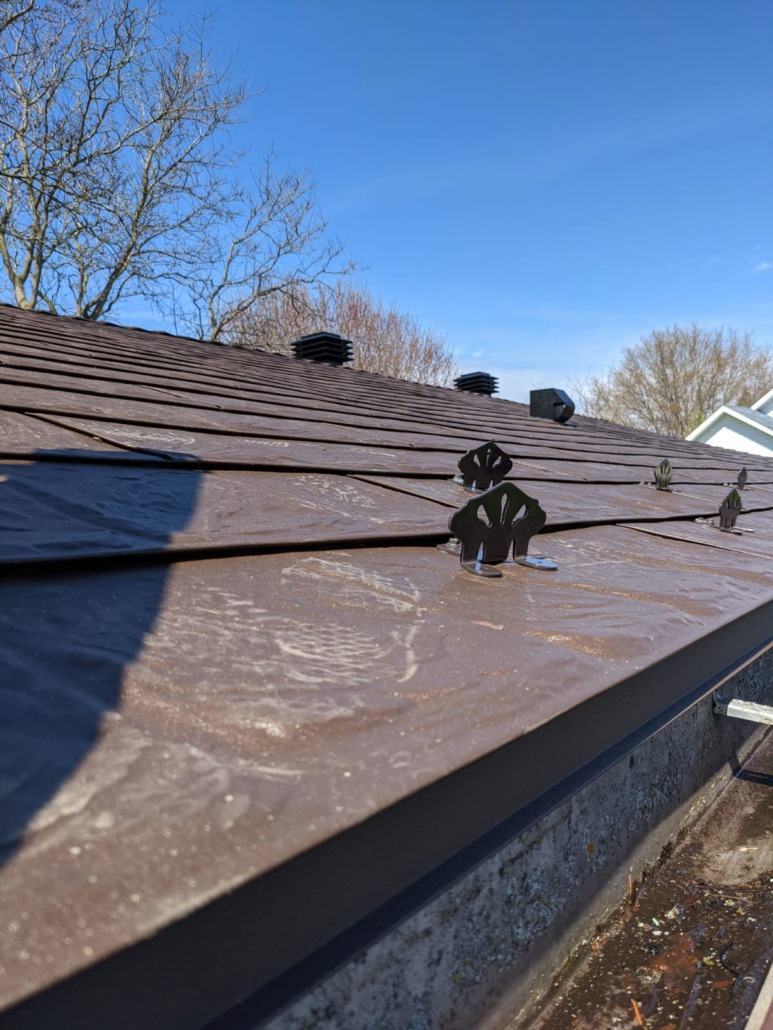
Snow guards on a metal shingle roof. Both systems shed fast and both need snow retention where people or property sit below.
The one edge goes to standing seam, and it’s the same edge that shows up everywhere else in this comparison: ice damming. Because standing seam can run on a much lower slope and is the more waterproof system when water backs up and sits behind an ice dam, it holds up better in the areas most prone to that. If you’ve got a stubborn ice-dam spot, that’s a point in standing seam’s favour.
What each costs — and exactly why
On new construction, the two systems price out pretty close. On a reroof, standing seam usually costs meaningfully more — and the reason is worth understanding, because it’s almost entirely about prep, not the metal itself.
A standing seam panel is flat, and it sits directly on the substrate. That means any unevenness underneath — the ridges and valleys of old shingles, a wavy deck — telegraphs right through that flat face and shows. So to run standing seam on a reroof, we either tear the old shingles off, or we double-strap and shim the roof to build a dead-flat plane, and add high-heat ice-and-water underneath. That’s real labour.
Steel shingles are formed, three-dimensional pieces that don’t lie flat against the deck. Their profile hides what’s underneath — so even with old shingles still down, the imperfections don’t show through the new steel. Less prep, lower labour, lower price.
✓ Where your money actually goes
Material costs between the two are essentially the same. The reroof price gap is almost pure labour — the prep to get standing seam a much flatter surface to sit on. Could you lay standing seam right over old shingles to save that? Functionally, yes — but imperfections are more likely to show through, so when you’re pricing this out, it’s a good idea to make sure you’re comparing apples to apples between quotes.
Down the road: repairs and modifications
Say it’s fifteen years from now and a branch comes down, or you want to add a skylight. Can these be fixed? Yes — both of them, right in the middle of the roof. But I’ll be straight with you: it’s never fun. Nobody looks forward to opening up a finished roof, on either system.
Here’s the wrinkle most people don’t expect: ease of repair tracks the specific system, not just the standing-seam-vs-shingle category. Among standing seam, snap-lock is actually one of the easiest roofs to swap a panel on in the field — a genuine advantage it has over mechanical-lock standing seam, which takes more work to open up. And among shingles, the metal matters: an aluminum shingle comes out far more easily than a steel one. So “which is easier to repair?” doesn’t have a clean category winner — it depends on the lock type and the material.
So… is one of them just better?
People ask me this directly, and they almost always follow it with: “What do you have on your property?”
The answer: I have both — on my shop. It’s got metal shingles, with a substantial standing seam accent on the shed dormer. I didn’t crown one winner even there — I used each where it made the most sense. That’s not a dodge; that’s the honest reality of how good these two systems are.
But if you truly corner me and say “rank them” — if you ran both products through every identical test to see which failed first — I believe standing seam is probably the top-performing metal roof, and would likely outlast the shingle in more categories. I want to be clear about the size of that gap, though: it’s a photo finish. Steel shingles hold up great, with essentially no real-world problems. These are two excellent roofs — not one good one and one bad one.

Standing seam on a Cambridge home. If forced to rank raw performance, it edges ahead — but it’s a narrow margin over a shingle that performs excellently in its own right.
The honest case for steel shingles
Since I gave standing seam the slight nod on paper, let me make sure the shingle gets a fair shake — because there are real, informed reasons to choose it.
The biggest one is the look, and it’s more than personal taste. A lot of homeowners look at standing seam and see a barn or an agricultural building — those vertical panel lines could also read “industrial” to them, and they don’t want their home to look that way. This is exactly where steel shingles shine: they give you a permanent, four-way-locked metal roof that doesn’t look like metal at all — it reads as a traditional shingle or shake. For the right house and the right homeowner, that’s the deciding factor, full stop.
On top of the look, you’ve got the two practical wins from earlier: on a reroof they usually cost less, and their profile hides an uneven deck that standing seam would put on display. So steel shingles aren’t a fallback. On the right house, they’re the smarter choice.
There’s one more honest point in the shingle’s favour: oil canning. Every standing seam roof oil-cans to some degree — that slight waviness you can catch across a flat panel in certain light. To be clear, it’s a natural characteristic of standing seam, not a defect, and we spell that out in writing on our contracts so nobody mistakes it for a flaw. But steel shingles essentially don’t oil-can, because the stamped profile breaks up the flat plane where it would show. If a perfectly smooth-looking roof matters to you, that’s a real mark in the shingle’s column.
How the decision actually gets made
When someone’s genuinely on the fence — same house, could go either way — the decision almost always lands on one of three things.
| If this is your priority… | …here’s where it points |
|---|---|
| Cost, especially on a reroof | Steel shingles usually come in lower, because they skip the tear-off / strap-and-shim prep standing seam needs. |
| The look you love | Pure preference. Clean modern vertical lines → standing seam. Traditional, non-industrial, “doesn’t look like a barn” → steel shingles. |
| Future solar | Standing seam. Solar mounts to the seams with clamps that grip the panel — no holes drilled through the roof — where a shingle roof has to be penetrated to mount. If solar is anywhere in your plans, that tips the scale. |
| Raw, on-paper performance | Standing seam by a hair — but both are excellent, so this rarely decides it on its own. |
How to tell a quality install from a cheap one
This is the part I most want you to take away, because the difference between a roof that lasts 40–50 years and one that disappoints is usually the install, not the product name on the quote. Here’s what to ask and watch for on each system.
On standing seam: no exposed fasteners — anywhere
The entire point of standing seam is concealed fasteners. So the red flag is exposed fasteners where there should be a lock. I see homeowners who bought a “standing seam” roof that still has screws driven right through the panels — usually at the drip edge (where the panel should have a lock bent on the bottom and hooked onto the drip edge, instead of being run long and screwed through the face), and often at gables and valleys too.
Those are the most vulnerable areas on the whole roof — the bottom edge and the valleys, where water concentrates. A screw through the panel there defeats the purpose of the system. Ask any standing seam installer directly how they finish the eaves, gables, and valleys. The answer should be locks, not screws.
On steel shingles: confirm it’s four-way locking
Because “steel shingle” covers such a wide range of products, make sure you’re comparing like for like. A dramatically cheaper shingle quote is often the tell that it’s not a four-way lock — it might lock only top-and-bottom, only the sides, or just overlap on all four sides with exposed fasteners. Ask the question plainly: is this a four-way locking, concealed-fastener shingle? If it isn’t, that price difference isn’t a deal — it’s a different, lesser product.
⚠ The one I’d avoid entirely
Stone-coated steel shingles — steel with asphalt-style granules glued on — look great when they’re new, but they won’t make fifty years without badly deteriorating, the same way asphalt streaks and sheds its granules. In fourteen years I’ve never installed one and never will. I consider it one of the worst metal roofing products on the market.
The bottom line
Here’s how I send homeowners off. Drive around. Look at different roofs and different styles. Find the ones you actually love on real houses. And take your time with it — a metal roof is going to be up there for a very long time, so it’s not a decision to rush.
Because at the end of the day, both a true standing seam roof and a four-way locking steel shingle are going to be a great choice for most homes. Get the install right, pick the look you love, and you genuinely can’t go wrong between these two.
Still torn between the two?
Tell us about your roof and what you’re picturing. We quote both systems side by side, honestly — and we’ll flag anything you should know before you decide.
Leave a Reply
Want to join the discussion?Feel free to contribute!