
If you’re weighing a metal roof against asphalt shingles, there’s one thing I want you to understand before we get into anything else: a quality metal roof is going to cost more money than an asphalt shingle roof. That’s the honest starting point, and everything else in this comparison flows from it.
I’ve spent the last 14 years doing nothing but metal roofing, and before that I was installing asphalt shingles. So I’ve stood on both kinds of roofs, in every season we get here in Southern Ontario, and I’ve watched how both materials age over time. This isn’t a sales pitch. It’s what I’ve actually seen in the field — including the times asphalt makes sense and the myths about metal that just aren’t true.

Black standing seam installation in Cambridge, ON — Advanced Metal Roofs.
Let’s start with the hard truth: metal costs more
I’d rather get this out of the way first than dance around it. If you want a quality metal roof, you’re going to pay more than you would for asphalt shingles — and there are a few different things stacking up to make that true.
The material itself costs more. Asphalt shingles are going to run you somewhere around a third of the cost of metal roofing, or even less. That’s a big gap, and it’s the first thing people notice when they start getting quotes.
You’re paying for a lot more labour. Roofing an average house with asphalt shingles is a lot faster than doing it in metal. A metal roof is far more man-hours. So you’re not just paying for more expensive material — you’re paying for the additional time and skill it takes to install it properly.
And there are specialty tools involved. A proper metal install requires equipment that an asphalt crew simply doesn’t need. Those tools, and the know-how to use them, are part of what you’re paying for.
So when you see that higher number on a metal roofing quote, that’s where the money is going. It’s not arbitrary. It’s more material cost, more labour, and the specialized work that goes into doing it right.
So what are you actually getting for that extra money?
Here’s the other side of the ledger — and this is where my 14 years really shape how I see it. When you invest in a quality metal roof, what you’re buying is peace of mind. Peace of mind that your roof is going to hold up to all the harsh weather we get, and that you’re not going to be calling somebody out to patch it.
If it’s a quality metal roof — quality paint, installed properly — you’re looking at a maintenance-free roof for 50-plus years. No babysitting it. No service calls. No wondering whether this is the year it finally starts leaking. That’s a fundamentally different ownership experience than an asphalt roof, and it’s the heart of why people make the switch.
Where metal really pulls ahead: the weather
People expect me to say metal wins on every weather front. The honest answer is more specific than that, and the headline is wind.
A quality metal roof installed properly has a much higher wind rating than an asphalt shingle roof. But here’s the part that really matters, and the part most comparisons skip over entirely: that wind rating doesn’t decrease over the life of the roof. An asphalt shingle’s wind resistance does. As shingles age, they get more vulnerable to wind — but a properly installed metal roof holds its wind performance for its entire life. That’s a huge difference when you live somewhere that gets the wind events we do.
There are also metal roofing options that stand up better to ice damming and the problems that come with it, and metal’s smooth surface sheds snow more readily than a shingle roof. But if I had to name the single biggest weather advantage metal has over asphalt, it’s wind — and the fact that the advantage doesn’t fade as the roof gets older.

Standing seam installation in Waterloo — built to hold its wind rating for the life of the roof.
How an asphalt roof actually ages (the part you don’t see from the ground)
To really understand this comparison, it helps to know how an asphalt shingle is built and what happens to it over time. I see it up close on roofs all the time, but a homeowner standing on the ground never does.
An asphalt shingle is built on a mat — that’s the base of the shingle, made of fiberglass. There are oils in that original mat. Then on top of the mat they apply the granules — the coloured granules everybody sees on the surface of the shingles.
What happens around the 10 to 15 year mark is those granules start to come off. You’ll start seeing more and more of them in your eavestroughs, washing down your downspouts. That’s the sign. That’s the last breath of your shingles. And once they start to deteriorate, it usually speeds up significantly.
Granule loss isn’t the only signal, either. As shingles reach the end of their life, they also start to curl and delaminate. So between the granules in your eavestrough and the curling on the roof, those are the visible signs that an asphalt roof is on its way out.
- Granules in the eavestroughs and downspouts — the protective surface is wearing off, usually starting around year 10 to 15.
- Curling and delamination — the shingles themselves are breaking down and lifting.
- Accelerating decline — once it starts, it doesn’t hold steady. It gets worse faster.
Compare that to metal, which doesn’t shed a protective surface the way asphalt does. There’s no granule layer to wear away, no mat to delaminate. That’s a big reason the maintenance-free lifespan is so different between the two.
Energy efficiency: two things most people don’t realize
Metal roofing helps with energy efficiency in a couple of different ways, and it’s worth understanding both because the second one tends to get missed entirely.
First, the paint. There are different paint systems out there, and they affect how much UV radiation and solar reflection you get off the roof. A quality reflective finish bounces more of the sun’s energy away instead of letting it soak in.
Second — and this is the one people overlook — the way a metal roof is formed. Because of its profile, a metal roof isn’t sitting flat and tight against the roof deck the way shingles do. That creates an air space between the metal and the deck, and that air space stops heat from transferring directly down into the attic. The result is a cooler attic, which helps with your cooling costs in the summer months.
So it’s not just “metal reflects heat” like you’ll read everywhere else. There’s the reflectivity of the coating, and there’s the air gap from how the roof is built — a structural advantage that has nothing to do with paint at all. Both work in your favour through our hot Ontario summers.
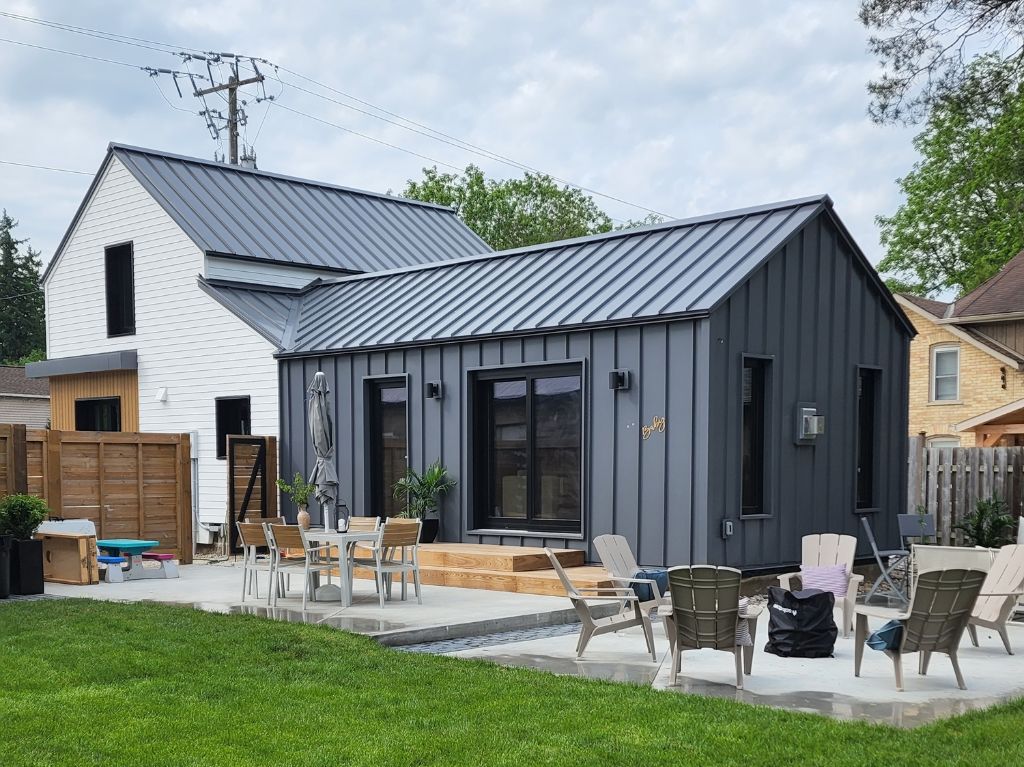
Black standing seam roofing and siding in Guelph, ON — Advanced Metal Roofs.
Who actually comes to us for metal
Most of our customers have already had numerous experiences with asphalt roofing. They’ve had it on their house — sometimes more than once — and they aren’t happy with how it performed or how it aged. They’re frustrated that they have to do it again.
That frustration is the throughline for the majority of the people we work with. The other big group is people building new custom homes who simply don’t want to be redoing their roof every 15 to 20 years. They’re thinking long-term from the start, and they don’t want a roof that puts them back in the shopping cycle a decade down the road.
Both groups are really telling me the same thing: they’re tired of the asphalt cycle, and they want out of it.
So when is asphalt actually the right call?
From a performance standpoint, there’s almost no application where asphalt suits a roof better than metal. So the honest answer really comes down to one thing: budget. If a metal roof doesn’t fit yours right now, asphalt is a perfectly reasonable choice, and there’s nothing wrong with that.
The one reason I’d push back on is the one I hear most: “I’m not staying in the house long enough to justify metal.” A metal roof adds resale value in a way an asphalt roof doesn’t, so that argument is weaker than it sounds. But if it comes down to dollars and metal isn’t in the cards today, asphalt will still put a solid roof over your head.
Common myths about metal roofs
After 14 years, there are a handful of misconceptions I find myself correcting over and over. If you’ve been hesitant about metal because of any of these, let me clear them up.
If someone hasn’t looked into metal roofing, they often picture sheet steel or barn steel — and understandably, they don’t want their house to look like a barn. But that’s outdated. There are a lot of different styles of metal roofing out there now, including products that look like shingles, slate, or shake. Your house does not have to look like a barn.
On a typical house — where you’ve got ceiling insulation and an airspace above the insulation — you’re most likely not going to hear average rain inside the house with your windows closed. In a heavy rain, you’ll hear it inside whether you have asphalt shingles or metal. The idea that a metal roof turns every rainfall into a racket inside your home just isn’t accurate for normal house construction.
They don’t. Lightning is attracted to the highest point. If your house is up on a hill, it can get struck no matter what’s on the roof — metal or not. The roofing material isn’t what’s drawing the lightning in.
This one depends heavily on the product. Some are easier to walk on than others. With some products, a dent can compromise integrity — but with others, a dent doesn’t affect performance at all. And a lot of these products are very textured, so even if there’s a minor dent from someone walking on the roof, you can’t see it from the ground.
The bottom line after 14 years
Here’s my honest opinion, plain as I can put it. A metal roof might be the right choice for you if:
- You don’t want to deal with service calls on your asphalt shingles.
- You don’t want the hassle of shopping for a new roof every 15 to 20 years — something most people don’t get excited to shop for.
- You’re looking to make an environmentally friendly choice — a product that can be completely recycled at the end of its life, rather than asphalt shingles, which will almost certainly end up in a landfill.
If those things matter to you, and a metal roof fits your budget, then in my experience it’s the better roof — and it’s not particularly close. The higher upfront cost buys you decades of not thinking about your roof, better performance against the weather we actually get here, and a material you can feel good about. That’s the trade I’d make every time.
Thinking about metal for your home?
After 14 years installing metal roofing across Southwestern Ontario, we’ve seen just about every roof situation imaginable. We’re happy to give you a straight answer about whether metal makes sense for your home.
Leave a Reply
Want to join the discussion?Feel free to contribute!